[:sk]Blízke veci / KVET NGUYEN[:en]Close Things / KVET NGUYEN[:]
[:sk]O pohľadnici, za ktorej okraje nikdy neuvidíme.[:en]About a postcard whose edges we will never see beyond.[:]
[:sk]Nájdené fotografie sú špeciálnou kategóriou blízkych vecí. Sú anonymnými momentami v čase, na ktoré natrafíme náhodou a niečím k nám prehovoria. Nájdená fotka predstavuje krátky okamih zo života niekoho, koho životnú realitu – pred a po tom, ako vznikol záber – nikdy nespoznáme.
Ak by sme mohli nazrieť do momentu, keď bola spravená fotografia, ktorú si vybrala Kvet, čo by sme uvideli za jej okrajmi? Aj v tomto prípade ostal len výsek z (inscenovanej?) reality niekdajšej Francúzskej Indočíny, záber, ktorý precestoval tri krajiny, aby nakoniec skončil v rukách inej fotografky a provokoval ju otázkami.
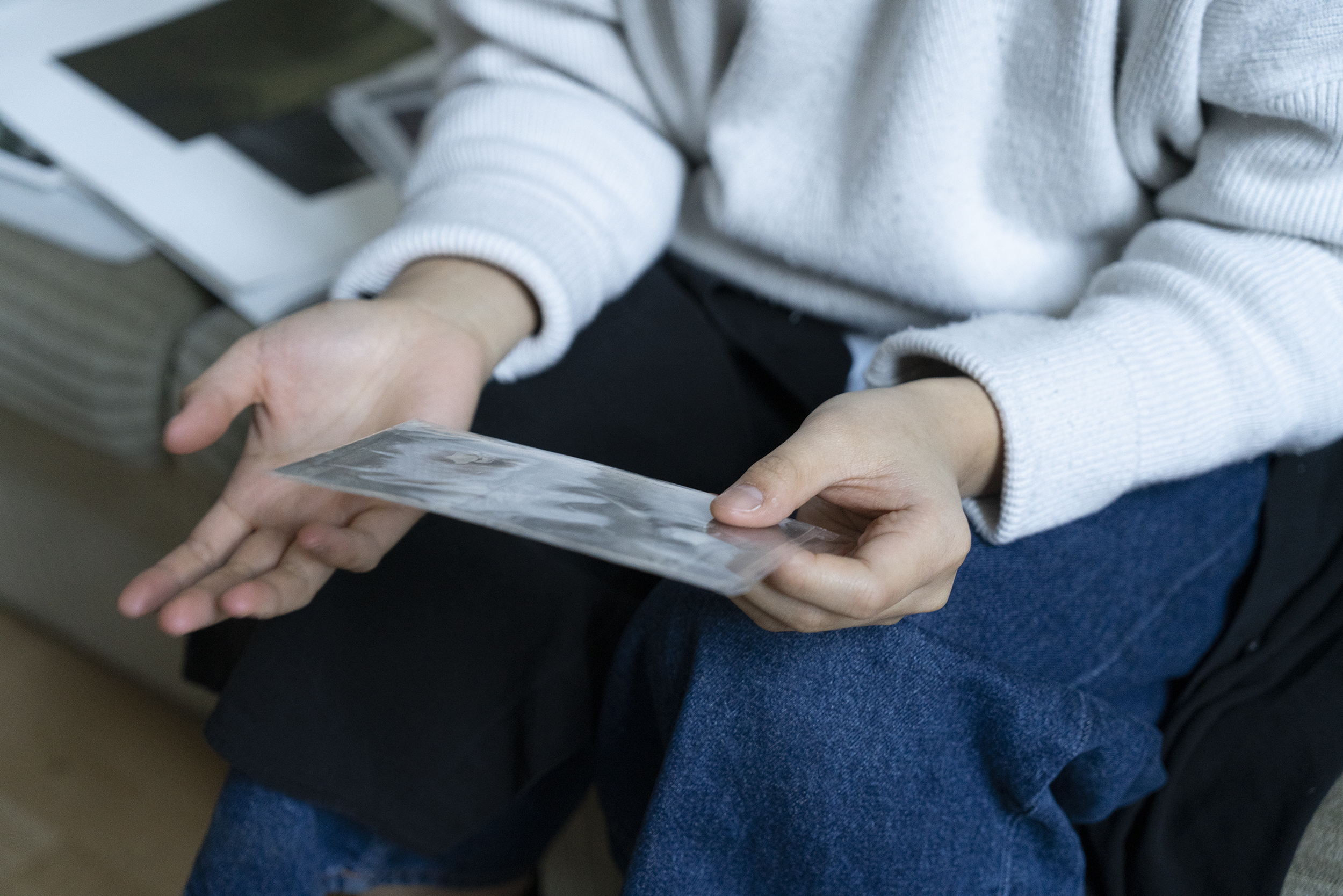
Zbierala si niekedy niečo? Alebo inak: funguje vo vašej rodine nejaká tradícia zbierania?
Ja so zbieraním väčšinou začnem a hneď aj prestanem, neviem v tom byť systematická. Ale moji rodičia zbierajú všetko (smiech). Hlavne teraz, keď sú starší, sa potrebujú obklopovať vecami, akoby sa obklopovali istotou. A zbierajú naozaj všetko: oblečenie, životné potreby, rastlinky, jedlo…
Keď tak premýšľam, čoho mám najviac ja…tak sú to výstrižky papierov, textov, poznámok, rôzne skice, fotky, o ktorých si myslím, že sa mi niekedy zídu, že ich raz nejakým spôsobom spracujem. Postupne sa hromadia, a ja potom neviem, čo s nimi.
Takže sú to vyslovene veci spojené s tvojou prácou.
Áno.
A ako sa k tebe dostal tento blízky – vzdialený objekt?
Pracovala som na mojej sérii Reframing Possibilities a táto pohľadnica patrila medzi fotky, ktoré som v nej analyzovala. Dostala sa ku mne asi polroka predtým, ako som začala vedome hľadať archívne fotografie z obdobia kolonializmu. Našla som ju v Holandsku, na blšáku v meste Haag, kde som v tom čase bývala. Vtedy som si len povedala – wow, super, pohľadnica z Indočíny, ale vôbec som si neuvedomovala historické súvislosti, teda to, že Indočína bola francúzskou kolóniou a to všetko za tým. Páčil sa mi jej vizuál. A až postupne sa ku mne dostal celý komplex toho, čo tá pohľadnica znamená.
O čom presne bol tvoj projekt Reframing Possibilities?
Projekt mal dve časti. V tej prvej som analyzovala archívne fotografie. Táto úvodná časť nikdy nebola oficiálne prezentovaná a predstavovala pre mňa skôr nejaký experiment s nájdeným materiálom. Ale spomínam na to rada, keďže to vznikalo počas pandémie a vtedy som mala možnosť naozaj sa zahĺbiť do práce. Výnimočne som nebola rušená žiadnymi inými aktivitami. Prajem si, aby sa mi to ešte niekedy podarilo.
Archívne fotky z Vietnamu (alebo bývalej Indočíny), ktoré som objavila, ma dosť zasiahli. Akoby do mňa vošiel ten Barthesov „šíp“, ktorý stále spomína v zmysle, ako vie fotografia zasiahnuť človeka. A ja som nad tými fotkami začala naozaj plakať, keďže na niektorých bola prítomná aj smrť. Prepojilo ma to s vietmanskou históriou. Boli to zvláštne pocity. Napriek tomu, že tú krajinu vlastne nepoznám – bola som tam doteraz asi štyrikrát – cítila som nejaké to puto, niečo vo mne stále žilo, a práve to som chcela ďalej analyzovať. Otvorila som archív, ktorý som objavila na internete, a to cez jedného pána, ktorý vo veľkom zbieral fotografie z Vietnamu – od vzniku fotografie až do súčasnosti. V tomto archíve som si našla pre mňa najťaživejšie zábery a vytlačila som si ich. A potom som chcela „naprávať“ tú históriu cez tieto fotky, tak, že som ich fyzicky manipulovala. To bola prvá časť projektu. V druhej časti som robila autoportréty, v ktorých som sprítomňovala to, čo pociťujem.
Ako presne si tieto zábery „naprávala“?
Bola tam napríklad fotografia žien, ktoré boli zobrazené nahé, ale takým spôsobom, že na ne bolo pozerané ako na objekty, nie na subjekty. Ja som ten papier skrútila, aby ich telá nebolo vidno. Inde som zase vystrihovala, prelepovala, prelamovala papier. Bola to taká experimentálna hra, bavilo ma to aj kvôli tomu, že som výnimočne nefotila, ale pracovala priamo rukami.
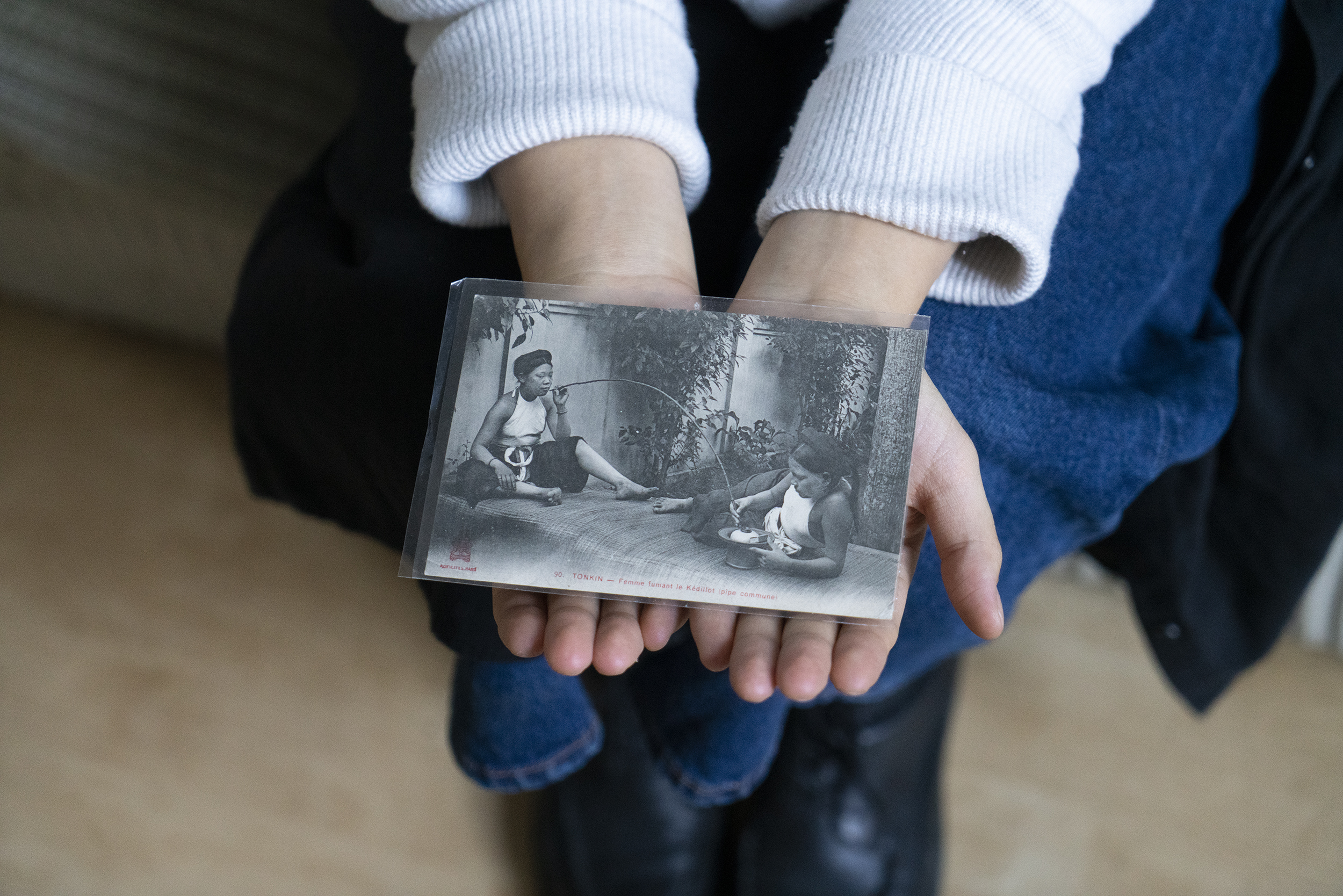
Poďme sa rozprávať o tej konkrétnej fotografii – pohľadnici, ktorú držíš v rukách. Čo presne ťa na jej vizualite zaujalo?
Je to čiernobiela analógová fotografia a sú na nej ženy, ktoré v tom období žili v Indočíne, teda na území Vietnamu. Zdalo sa mi zvláštne, že som ju našla až v Holandsku. Zaujal ma ten objekt, ktorý držia, pripomínajúci konárik – je to ópiová fajka. Ale na to, čo to je, som prišla až neskôr. Ani to neviem popísať, ale je také zvláštne, že som sa k tomu dostala na úplne neznámom mieste, skôr by som očakávala, že ju nájdem vo Francúzsku. Predstavujem si, že cestovala z Vietnamu do Francúzska a odtiaľ putovala rôznymi cestičkami do Haagu, k pánovi, ktorý tie fotky predával. A nakoniec som sa tam ocitla ja a zapôsobila na mňa taká jej zvláštna, priťahujúca energia.
Mňa na nej zaujalo to, že zobrazuje ženy, ktoré spolu trávia čas v nejakom rituále a prepája ich práve oblúk tej fajky. Predstavujem si, že na pozadí sa odohráva nejaký ich rozhovor.
Áno, zaujímavé je na tom to, že ja som si tú pohľadnicu vybrala práve na základe toho pekného, romantizujúceho vizuálu. Ale reálne to má aj svoju temnú stránku. Ten záber má v sebe kontroverziu.
Metaforicky by sa dalo hovoriť o tej druhej, či odvrátenej strane pohľadnice. Čo myslíš, že je skryté na pozadí tejto scény?
Tieto pohľadnice v podstate slúžili ako nejaká masová propaganda francúzskeho pôsobenia v Indočíne a toho, ako sa tam žije, pričom ukazovali nejakú nadradenosť voči indočínskemu národu. Pohľadnica bola v istom zmysle mocenským nástrojom.
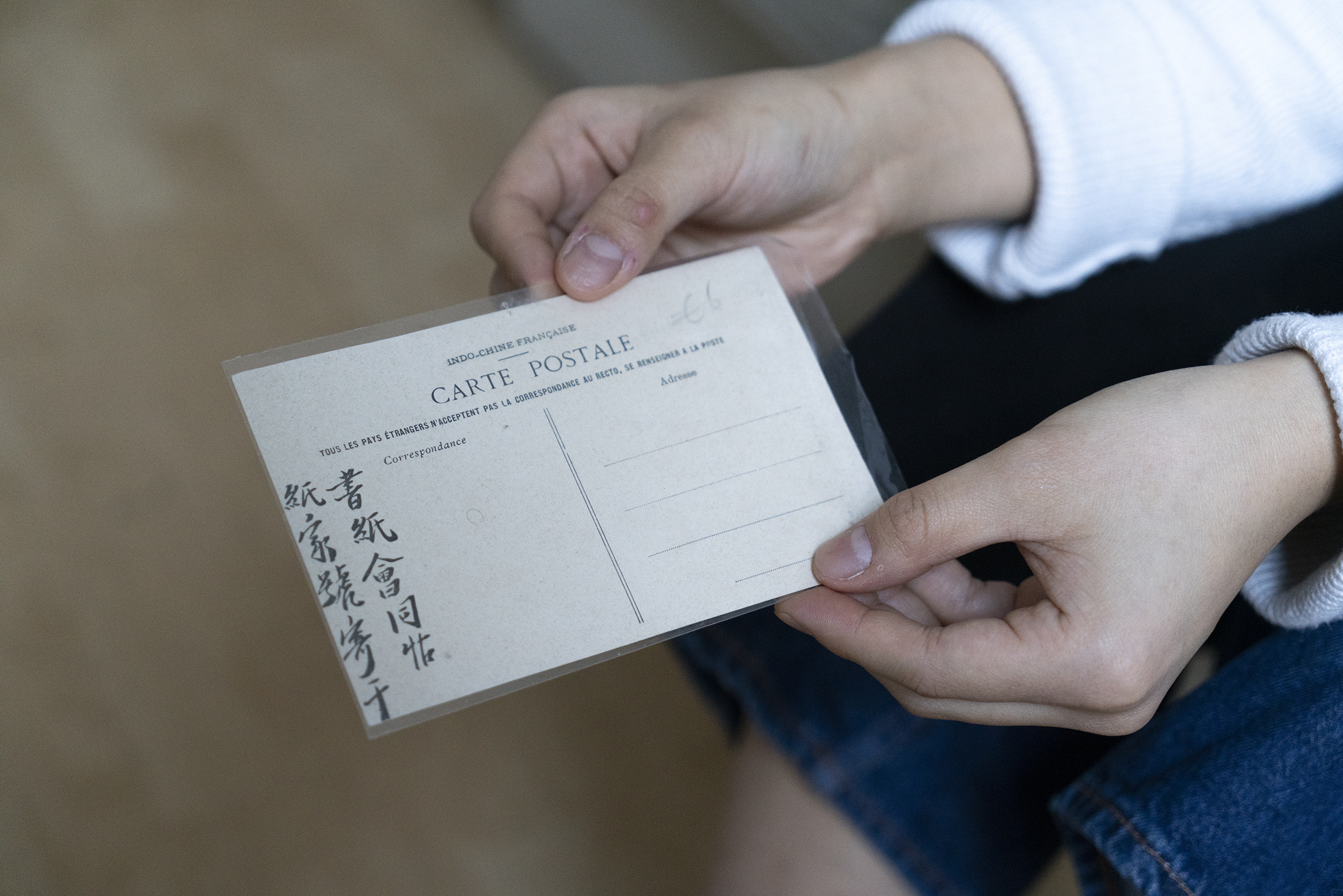
Podobne ako iné pohľadnice, ktoré zachytávajú Európe vzdialené (ale európanmi kolonizované) kultúry, aj toto je v podstate len nejaký malý výsek reality, ktorý exotizuje miestne obyvateľky…
Áno, stále sa rozprávame o fotografii. Rozmýšľam nad tým, či tie ženy reálne užívali ópium, alebo je to skôr scéna vytvorená pre fotografiu. Keďže v tom období nemali tamojšie ženy v spoločnosti nejaké vysoké postavenie a ópium užívali skôr muži. Zároveň, jedna z nich vyzerá byť tou podradenejšou, pravdepodobne je to slúžka, a tá druhá, ktorá drží konárik, je buď domáca alebo žena v nejakej vyššej pozícii.
Teraz, keď to hovoríš, vnímam to aj ja. Je tam prítomná istá dynamika alebo hierarchia. Napriek tomu, že sú rovnako oblečené.
Videla som ešte jednu podobnú pohľadnicu, na ktorej bol muž, užívajúci ópium a vedľa seba mal nahú ženu vo zvláštnej pozícii. Ten záber vo mne vyvolal rôzne emócie, neviem ich ani popísať. Netuším, aká bola skutočná realita tých fotografií. Asi by som to chcela vedieť.
V tých časoch boli informačné zdroje, prostredníctvom ktorých sa dal spoznávať svet, obmedzené, a preto mala aj obyčajná pohľadnica istú moc, lebo zobrazila, ponúkla časť nejakej vzdialenej reality. A takto formovala poznanie sveta…
Presne tak, tieto obrazy mali manipulatívny charakter, ponúkali videnie sveta, ktoré sa obmedzovalo na tých, ktorí vládli, konkrétne tu išlo o francúzskych kolonialistov. Fotografie tak boli zámerne využívané v ich prospech. Bolo to veľmi rozšírené, a teraz sa v oblasti postkoloniálnych štúdií objavuje čoraz viac literatúry, ktorá hovorí o tom, ako sa vnímala exotika, ako sa prejavoval exoticizmus. V skutočnosti išlo o to, že cez tieto obrazy ukázali: pozrite sa na to, akí sú iní. A často to bolo myslené negatívne.
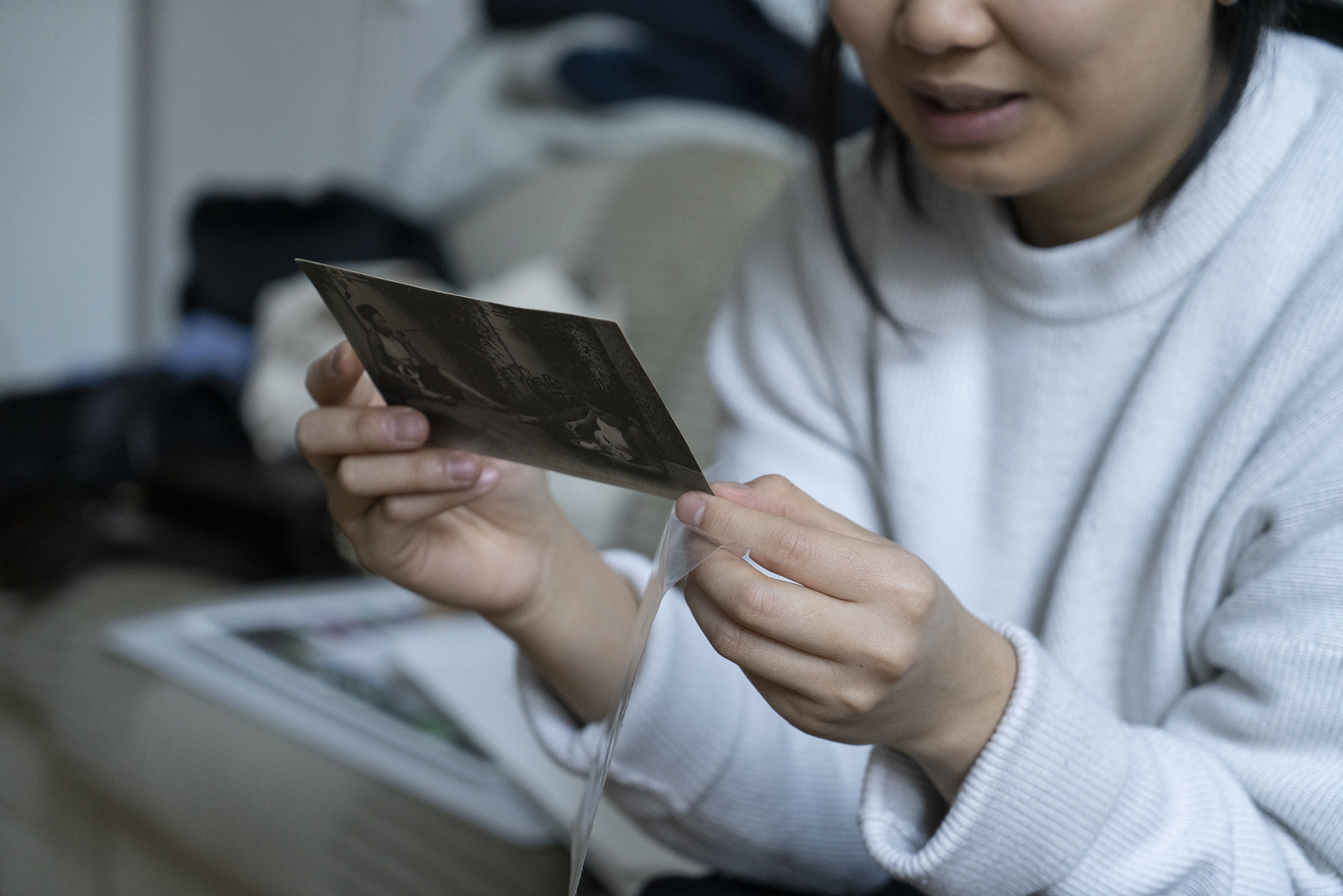
Kvet Nguyen (Hoa Nguyen Thi) – sa narodila v roku 1995. Absolvovala štúdium fotografie na bakalárskom a magisterskom stupni na VŠVU. V roku 2021 získala ocenenie Nadácie Tatra Banky v kategórii Mladý tvorca. Kvet Nguyen sa aktívne venuje témam inakosti a identity nielen vo svojich umeleckých projektoch, ale snaží sa o tom otvorene rozprávať a otvárať diskusiu aj v rámci rozhovorov alebo iných platforiem.
[:en]Found photographs are a special category of close things. They are anonymous moments in time that we stumble upon by chance and speak to us in some way. A found photo represents a brief moment in the life of someone whose life reality – before and after the shot was taken – we will never know.
If we could peer into the moment when the photograph Kvet has chosen was taken, what would we see beyond its edges? In this case, too, only a slice of the (staged?) reality of what was once French Indochina remained, a shot that traveled through three countries to end up in the hands of another photographer, provoking her with questions.
Have you ever collected anything? Or else: is there a tradition of collecting in your family?
I usually start and stop collecting, I can’t be systematic about it. But my parents collect everything (laughs). Especially now that they’re older, they need to surround themselves with things, like surround themselves with security. And they really collect everything: clothes, necessities of life, plants, food…
When I think about what I have the most of…it’s scrapbooks of papers, texts, notes, various sketches, photos that I think I’ll get my hands on someday, that I’ll process in some way. Gradually they accumulate, and then I don’t know what to do with them.
So it’s pronouncedly stuff related to your work.
Yeah.
And how did this close-distant object come to you?
I was working on my Reframing Possibilities series and this postcard was one of the photos I analysed in it. It came to me about six months before I started consciously searching for archival photographs from the colonial period. I found it in the Netherlands, in a flea market in Hague, where I was living at the time. At the time I just thought – wow, cool, a postcard from Indochina, but I was completely unaware of the historical context, i.e. that Indochina was a French colony and all that behind it. I liked the visuals of it. And it was only gradually that the whole complexity of what the postcard meant came to me.
What exactly was your Reframing Possibilities project about?
The project had two parts. In the first one, I analyzed archival photographs. This initial part was never officially presented and was more of an experiment with found material. But I remember it fondly, as it was created during the pandemic and that was when I had the opportunity to really dig into the work. Exceptionally, I was not disturbed by any other activities. I wish I could do that again.
The archival photos from Vietnam (or former Indochina) that I discovered hit me quite hard. It’s as if that Barthes “arrow” that Barthes keeps mentioning in terms of how a photograph can strike a person has entered me. And I really started to cry over those photos, as death was present in some of them. It connected me to the history of the Vietnamese. It was a strange feeling. Even though I didn’t really know the country – I’d been there about four times so far – I felt a connection, something was still alive in me, and that’s what I wanted to analyse further. I opened an archive that I discovered on the Internet, through a gentleman who had been collecting photographs of Vietnam in large numbers – from the beginning of photography to the present day. In this archive, I found the most difficult images for me and printed them out. And then I wanted to “correct” that history through these photos, by physically manipulating them. That was the first part of the project. In the second part, I made self-portraits in which I was mirroring what I was feeling.
How exactly did you “fix” these shots?
For example, there was a photograph of women who were depicted naked, but in such a way that they were seen as objects, not subjects. I twisted the paper so that their bodies were not visible. Elsewhere, I cut out, taped over, folded the paper. It was such an experimental game, I enjoyed it also because I exceptionally didn’t take pictures, but worked directly with my hands.
Let’s talk about that particular photo – the postcard you’re holding in your hands. What exactly attracted you to its visual appearance?
It’s a black-and-white analogue photograph, and it shows women who were living in Indochina, which is Vietnam at that time. I thought it was strange that I only found it in the Netherlands. I was intrigued by the object they are holding, which resembles a twig – it is an opium pipe. But I didn’t find out what it was until later. I can’t even describe it, but it’s so strange that I came across it in a completely unfamiliar place; I would have rather expected to find it in France. I imagine that she travelled from Vietnam to France, and from there she travelled through various paths to Hague, to the gentleman who sold the photos. And finally I found myself there, and I was impressed by her strange, attracting energy.
What struck me about it is that it depicts women spending time together in some kind of ritual, and it is the arc of the pipe that connects them. I imagine that there is some sort of conversation going on in the background.
Yes, what’s interesting about it is that I chose that postcard based on that nice, romantic visual. But realistically, there’s a dark side to it. That shot has controversy in it.
Metaphorically, one could talk about the other, or the flip side of the postcard. What do you think is hidden in the background of this scene?
These postcards basically served as a kind of mass propaganda for the French presence in Indochina and how life was lived there, showing some kind of superiority to the Indochinese people. The postcard was, in a sense, a power tool.
Like other postcards that depict cultures far from Europe (but colonized by Europeans), this is essentially just some small slice of reality that exoticizes the locals…
Yes, we’re still talking about photography. I’m wondering if the women were actually using opium, or if it’s more of a scene created for a photograph. Because at that time women didn’t have any high status in the society and opium was more used by men. At the same time, one of them seems to be the more inferior one, probably a maid, and the other one holding the branch is either a housewife or a woman in some higher position.
Now that you say that, I sense that as well. There’s a certain dynamic or hierarchy present there. Despite the fact that they are equally dressed.
I saw another postcard similar to this where there was a man taking opium and he had a naked woman next to him in a strange position. That shot evoked different emotions in me, I can’t even describe them. I have no idea what the actual reality of those photographs was. I guess I would like to know.
In those times, the sources of information through which one could get to know the world were limited, and that is why even an ordinary postcard had a certain power, because it displayed, offered a part of some distant reality. And this is how it shaped the knowledge of the world…
Exactly, these images had a manipulative character, they offered a vision of the world that was limited to those who ruled, namely here the French colonialists. The photographs were thus deliberately used to their advantage. It was very widespread, and now there is a growing literature in the field of postcolonial studies that talks about how the exotic was perceived, how exoticism was manifested. It was really about showing through these images: look at how different they are. And often it was meant negatively.
Kvet Nguyen (Hoa Nguyen Thi) – was born in 1995. She studied photography at the Bachelor and Master level at the Academy of Fine Arts and Design in Bratislava. In 2021, she won the Tatra Banka Foundation’s award in the Young Creator category. Kvet Nguyen is actively engaged in the topics of otherness and identity not only in her artistic projects, but also tries to talk openly about it and open a discussion within interviews or other platforms.
[:]