[:sk]Esej / INTRO[:en]Essay / INTRO[:]
[:sk]O utopickom koncepte v architektúre[:en]On the utopian concept in architecture[:]
[:sk]
Intro
Architektúra dokáže vytvoriť (lepšie) miesto pre život. Škála spôsobov akými sa o to snaží je široká. Od komfortných loosovských interiérov, cez úslužnosť funkcionalizmu po dnešnú uživateľsky optimalizovanú architektúru. Od otázky kvality zastrešovania nášho každodenného života po produkciu výnimočných zážitkov. Viac ako spôsoby, akými architektúra zlepšuje naše životné podmienky, ma v prvom rade zaujíma pôvod tejto idey zlepšovania.
Utopický koncept architektúry ako mýtus moderny
Pri otázke (hľadania, definovania) miesta, kde by nám malo byť všetkým dobre, sa automaticky ponúka pojem Utópia. Zygmund Bauman načrtáva pôvod Utópie na pozadí prelomového, násilného, neistého sveta 16. storočia, kedy sa náhle búrali staré zvyky a tradície. Utópia podľa neho označuje predstavu usporiadaného, predvídateľného, bezpečného sveta, predstavu dobrej spoločnosti[1].
Utópia, spolu s jej architektonickým dôsledkom v koncepte Ideálneho mesta, je zviazaná s počiatkom moderného myslenia. Úlohu architektúry explicitne zlepšovať život/ svet/ spoločnosť teda nazývam mýtom moderny. Mýtom preto, že síce sa táto otázka zdá byť dnes už prirodzená a nespochybniteľná, predsa len vznikla v určitom historickom momente.
Roland Barthes vysvetľuje mýtus cez semiológiu, ako sekundárny systém, tvrdenie, ktorého funkciou je deformovať, vyprázdňovať skutočnosť. To čo deformuje, vyprádzňuje je pôvodný zmysel (primárny systém). V tom prípade, mýtus architektúry ako nástroja budovania lepšieho sveta vznikol vyprázdnením pôvodného významu architektúry.[2] Znamenalo by to, že architektúra primárne neslúži pre niekoho “dobro” ako také, ale má iný (pôvodný?) zmysel.
Predstava_Projekt
Barthesova teória hovorí ďalej o tom, že spojenie vyprázdneného zmyslu/ formy (architektúra) a konceptu (predstavy lepšieho sveta) do mýtu nie je arbitrárne, ale motivované. To znamená, že existujú analogické aspekty, tj. ekvivalentné vlastnosti architektúry a predstavy dobrej spoločnosti na základe ktorých je toto spojenie možné.[3]
Vzťah architektúry a dobrej spoločnosti v kontexte Utópie/ Ideálneho mesta je možné popísať na základe jednotlivých konkrétnych predstáv, alebo všeobecne, mimo ich obsahy. Tie sú totiž vždy odrazom špecifických dejinných situácií. Ak hovorím o Utópii/ Ideálnom meste všeobecne, myslím tým predstavu – projekt. Ide o to, že predstava (projekt) je zámerná, má vlastný vnútorný zmysel, je to konštrukcia. Vo (vlastnej – individuálnej/ skupinovej) predstave vieme určiť svoje miesto, vsadiť do nej všetko to, čo potrebujeme. Predstava je jasne stanovené a kontrolovateľné prostredie. Predstava (projekt) formuluje jeden konkrétny názor na fungovanie vecí. To by mali byť zároveň vlastnosti architektonického projektu ako takého.
Predstava_Obsah
Utópiu (Ideálne mesto) ako ju poznáme zo začiatku 16. storočia, približne do Francúzskej revolúcie nazýva Collin Rowe klasickou, ktorá ešte nepoznala mesianistický obraz architekta a radikálnu transformáciu stávajúceho rádu vecí ako tá modernisitická. Klasická utópia, ktorá bol skôr mentálnou ikonou dobrej spoločnosti, sa poposunula do aktivistickej postosvietenskej fázy. Okruh tých, ktorým bola adresovaná sa rozšíril na celú spoločnosť a jej ambície sa z úlohy obrazu, ktorý mal byť len obdivovaný, posunuli k predpisu, ktorý mal byť zrealizovaný.[4] Utópia 19. – začiatku 20. storočia sa stala priamym (politickým) nástrojom transformácie spoločnosti. V povojnovom období neskorej moderny sa tieto predstavy vytesnili z polohy ambicióznych vízií budúcnosti do autonómie sebestačných kritík spoločnosti. Z role politického nástroja moci do role ironických subverzívnych dystópií.
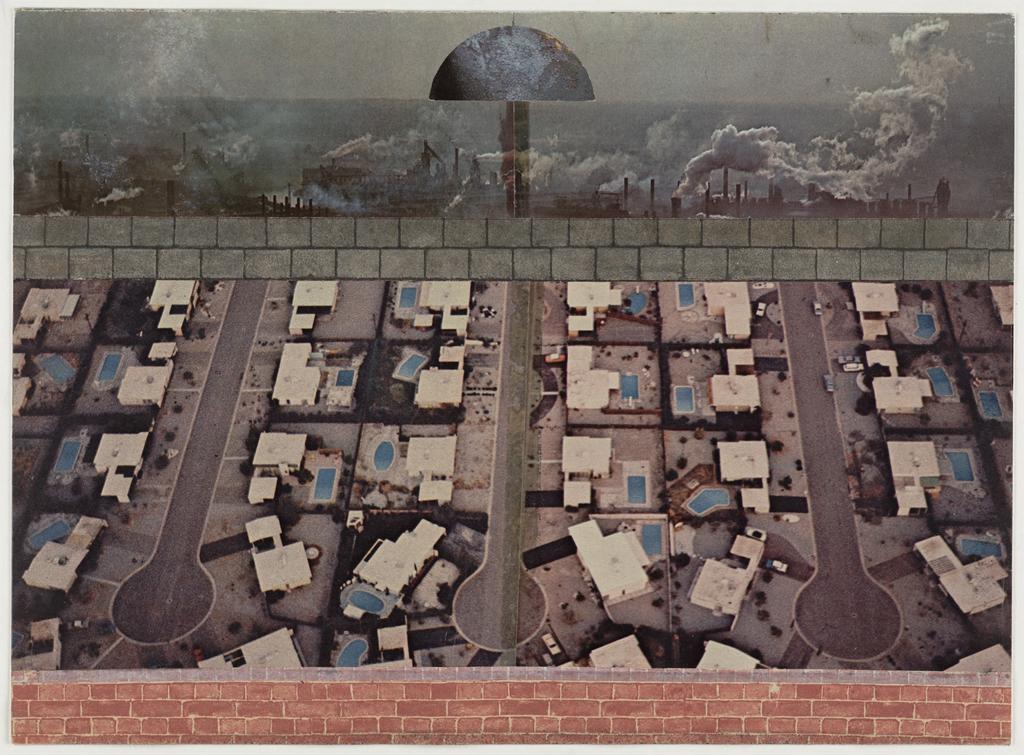
Rem Koolhaas: Exodus, 1972, zdroj: socks-studio.com
Stena_Kontinuum_Bigamia
“Exodus – or the Voluntary prisoners of architecture” je projektom Rema Koolhaasa v spolupráci s Elia Zenghelisom, Zoe Zenghelis a Madelon Viesendorp, pre súťaž organizovanú magazínom Cassabella v roku 1972 – “The City as meaningful environment”. Projekt naväzuje na fenomén, ktorému sa Koolhaas venoval už vo svojej diplomovej práci na Architectural Association – “The Berlin wall as Architecture”. Studená vojna, extrémne ideologicky polarizovaná spoločnosť, čiernobiele predstavy, ktorých nástrojom sa architektúra (ako stena) stáva. V Exode je umiestnená do kontextu Londýna a oddeľuje Dobrú a Zlú polovicu mesta. Tá Dobrá polovica je múrom obohnané väzenie spokojnosti. Ten kto sa rozhodne žiť v Dobrom meste sa automaticky stáva (dobrovoľným) väzňom architektúry.[5]
Opačným pólom je projekt “No-stop city”, talianskej skupiny Archizoom Associates z roku 1969. Zbavili mesto akejkoľvek artikulácie, formálnych alebo kompozičných problémov, akejkoľvek kvality. Mesto v ktorom absentujú “agresívne štruktúry architektúry”[6] a vlastne absentuje aj mesto. Množina jednotlivých predstáv, ktorou mesto bolo, sa stala jednou veľkou kontinuálnou a univerzálnou predstavou dobrej spoločnosti. Mesto vymenila nekonečná homogénna štruktúra pozostávajúca z obytných parkovacích miest, skladov, hygienických zariadení a banánov.
A potom tu je súčasná predstava žitej utópie. 8 House, polyfunkčný development na periférii Kodaňe od Dánskeho štúdia BIG, hovorí o nekonečnom šťastí. O (všemohúcej) architektúre ako priamom nástroji premeny snov na realitu. Spochybňujú nutnosť konečnej voľby, pretože architekt tu je na to, aby si vedeľ predstaviť čokoľvek, teda spojiť dokopy všetko to, po čom túžime. BIG si tento fenomén pomenuváva bigamia – množstvo požadovaných elementov, ktoré spolu môžu nesedieť, alebo sa aj priamo vylučovať, ale ich spojením vzniká nový žáner. “Nemusíme byť verný jednej predstave, ale spojiť množstvo ideí do promiskuitného hybridu.”Mestský blok + cestná štruktúra stredozemného horského mesta, to je 8House.
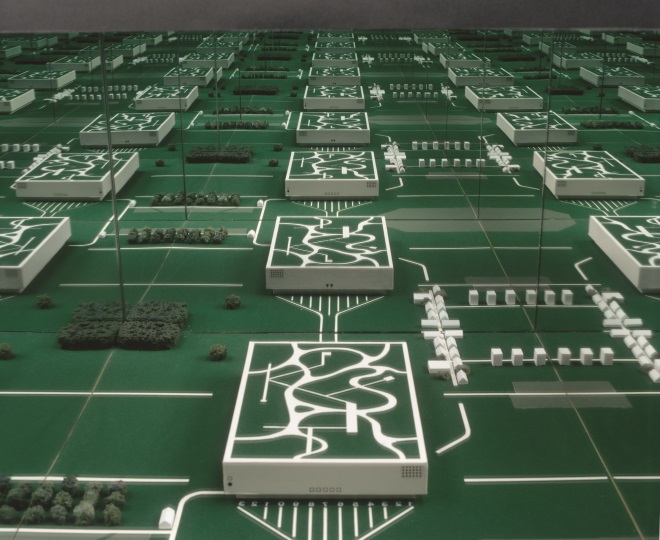
Andrea Branzi: No-Stop City, 1969, zdroj: https://www.architectural-review.com/essays/profiles-and-interviews/interview-with-andrea-branzi
Dobrá_Dobre
V prvom pláne, po tematickej stránke, tieto Predstavy / Projekty / Utópie / Ideálne mestá a dom ilustrujú miesto, kde nám bude všetkým spolu dobre (predpis) alebo zle (kritika). V druhom pláne je dôležité akým spôsobom používajú architektúru (aby nám bolo spolu všetkým dobre). Dobrá spoločnosť, o ktorej utópie hovoria neznamená primárne spokojnú spoločnosť. Dobrá spoločnosť a Ideálne mesto sú ideami štruktúrovanej spoločnosti skrze architektúru. Formalizácia určitého jasne čitateľného zámeru. Ak by som sa vrátila späť k analogickým aspektom architektúry a pocitu individuálnej /kolektívnej spokojnosti, je to ilúzia zmysluplnosti, (“The city as meaningful environment”), schopnosť orientácie v danom prostredí, pochopenie naprojektovanej situácie.
Exodus, cez čiernobielu optiku, hovorí o architektúre ako hranici konfrontácie rôznych názorov. O napätí, ktoré sa v No-stop city stratilo. Archizoom emancipuje spoločnosť vymazaním architektúry, ktorá je obrazom triedneho antagonizmu. Mesto sa rozplynulo v jednom definitívnom názore. Nastala trvalá hegemónia jednej predstavy (v tomto prípade predstavy “šedého, ateistického industrializmu”[7]). Zmizlo mesto ako “suma jednotlivých figuratívnych epizód”[8], tj.rôznorodosť názorov, ktoré majú svoje vlastné formálne prejavy.
Utópia v zidealizovanej (čistej) podobe formuluje cez architektúru určitú ideológiu. Ideológiu chápem ako vzťah spoločnosti k realite, spôsob akým si vysvetľujeme svet, súbor hodnôt,…Ilustruje funkciu architektúry ako artikuláciu názoru. Preto sa stáva politickým nástrojom spoločnosti. Spoločnosť je súborom rôznych perspektív, hodnôt a videní reality – ideológií. Tie si môžu byť blízke alebo absolútne sa vylučujúce, spoločnosť je pluralistická. Podľa Chantall Mouffe, (nevyhnutná) politickosť znamená rozhodovanie sa medzi konfliktnými alternatívami.[9]
Von
Podľa BIG je úlohou architektúry spojenie nespojiteľných ideí do jedného (vševyhovujúceho) celku. Hovorí o dobrej spoločnosti na základe maximalizácie obsahu do zradnej komplexnosti (naplnenia všetkých potrieb a túžob). Táto ideológia by sa dala prirovnať k tomu, čo Mouffe nazýva typické liberalistické chápanie pluralizmu. Ak spojíme všetky (protichodné) hodnoty dokopy, vytvoria spolu harmonický celok. Tento postup je založený na viere v univerzálny racionálny konsenzus založený na rozume, ktorý sám o sebe popiera politickosť – moment rozhodovania sa.
Proti možnosti úplnej objektivity a finálnosti konsenzu stavia Mouffe svoj koncept hegemónie. Každé aktuálne spoločenské zriadenie je vždy hegemonické, pretože vylučuje ostatné alternatívy. Zároveň (by malo byť) dočasné, kvôli emancipačným snahám potlačených alternatív.[10] To je predstava správne fungujúcej dynamickej demokracie. Architektúra materializuje, ohraničuje jednotlivé konzistentné ideové celky. Ale demokracia potrebuje (verejný) priestor. (Ideálne) mesto má poskytovať heterogenitu a priestor pre konfrontáciu – aby nám mohlo byť všetkým spolu dobre.
Exodus ukazuje architektúru ako “kondenzátor vytúžených možností”[11] spolu s jej odvrátenou stranou, keď sa stáva zároveň nástrojom uväznenia. Obraz metropoly desivý vo svojej totalite. Benefitom architektúry je aj jej vonkajšok, možnosť ju opustiť.
1 BAUMAN, Zigmunt. Všichni žijeme v utopii. In: Respekt, 2005, no. 24. Dostupné z: respekt.cz/tydenik/2005/24/vsichni-zijeme-v-utopii
2 BARTHES, Roland. Mytologie. Praha: Dokořán, 2004.
3 Barthes, R. Mytologie.
4 ROWE, Colin, KOETTER, Fred. Collage City. London: The MIT Press, 1978, s. 9 – 31.
5 KOOLHAAS, Rem, MAU, Bruce. S, M, L, XL. New York: The Monacelli Press, 1998.
6 BRANZI, Aandrea. Weak and Diffuse Modernity. The World of Projects at the beginning of the 21st Century. Milano: Skira editore, 2006, s. 18 – 22.
7 ARTEMEL, AJ. Retrospective: Archizoom And No-Stop City. In: Architizer. Dostupné z: https://architizer.com/blog/practice/details/archizoom-retrospective/
8 Branzi, A. Weak and Diffuse Modernity.
9 MOUFFE, Chantal. Agonistics. Thinking the world politically. London: Verso, 2013.
10 Mouffe, Ch. Agonistics.
11 WANG, Jun-Yang. Piranesi, Koolhaas, and the Subversion of the Concept of Place. In: Nordic Journal of Architectural Research. Dostupné z: arkitekturforskning.net/na/article/view/593
Text bol pôvodne publikovaný v časopise Projekt 1/2018. Text bol jednou z ocenených esejí v súťaži Píše ti architektúra? v roku 2018.
[:en]
Intro
Architecture can create a (better) place to live. The range of ways in which it tries to do this is wide. From comfortable Loosian interiors, through functionalism to today’s user-optimised architecture. From the question of the quality of the covering of our everyday life to the production of exceptional experiences. More than the ways in which architecture improves our living conditions, I am primarily interested in the origins of this idea of improvement.
The Utopian Concept of Architecture as a Myth of Modernity
In the question of (finding, defining) a place where we should all be well, the notion of Utopia automatically comes to mind. Zygmund Bauman sketches the origins of Utopia against the backdrop of the disruptive, violent, uncertain world of the 16th century, when old customs and traditions were suddenly torn down. According to him, Utopia denotes the idea of an ordered, predictable, secure world, the idea of a good society[1].
Utopia, along with its architectural consequence in the concept of the Ideal City, is tied to the beginning of modern thought. Thus, I call the role of architecture to explicitly improve life/world/society the myth of modernity. A myth because, although this question seems natural and unquestionable nowadays, it nevertheless arose at a certain historical moment.
Roland Barthes explains myth through semiology, as a secondary system, a proposition whose function is to distort, to empty reality. What it deflates, empties is the original meaning (the primary system). In that case, the myth of architecture as a tool for building a better world was created by emptying the original meaning of architecture.[2] It would mean that architecture does not primarily serve for someone’s “good” as such, but has a different (original?) meaning.
Idea_Project
Barthes’s theory goes on to say that the fusion of empty meaning/form (architecture) and concept (the idea of a better world) into myth is not arbitrary, but motivated. That is, there are analogous aspects, i.e., equivalent properties of architecture and the idea of the good society on the basis of which this connection is possible[3].
The relationship between architecture and the good society in the context of Utopia/Ideal City can be described on the basis of individual specific ideas, or in general terms, beyond their content. For these are always reflections of specific historical situations. When I speak of Utopia/Ideal City in general, I mean an idea – a project. The point is that the idea (project) is intentional, it has its own inner meaning, it is a construction. In (our own – individual/group) idea we can determine our place, put everything we need into it. The idea is a clearly defined and controllable environment. An idea (project) formulates one particular view of how things work. This should also be the characteristics of an architectural project as such.
Idea_ Content
Collin Rowe calls Utopia (the Ideal City) as we know it from the beginning of the 16th century, until about the French Revolution, the classical one, which did not yet know the messianic image of the architect and the radical transformation of the existing order of things as the modernist one did. The classical utopia, which was more of a mental icon of the good society, had moved into an activist post-Enlightenment phase. The circle of those to whom it was addressed expanded to include the whole of society, and its ambitions shifted from the role of an image to be merely admired to a prescription to be realised.[4] The utopia of the 19th-early 20th century became a direct (political) instrument for the transformation of society. In the post-war period of late modernity, these ideas were displaced from the position of ambitious visions of the future to the autonomy of self-sufficient critiques of society. From the role of a political instrument of power to that of ironic subversive dystopias.
Rem Koolhaas: Exodus, 1972, source: socks-studio.com
Wall_Continuum_Bigamy
“Exodus – or the Voluntary prisoners of architecture” is a project by Rem Koolhaas in collaboration with Elia Zenghelis, Zoe Zenghelis and Madelon Viesendorp, for the competition organized by Cassabella magazine in 1972 – “The City as Meaningful Environment”. The project relates to a phenomenon that Koolhaas had already addressed in his thesis at the Architectural Association – “The Berlin wall as Architecture”. The Cold War, an extremely ideologically polarised society, black and white ideas, of which architecture (as a wall) becomes an instrument. In Exodus it is placed in the context of London and separates the Good and Evil half of the city. The Good Half is a walled prison of complacency. Whoever chooses to live in the Good City automatically becomes a (voluntary) prisoner of architecture[5].
The opposite pole is the “No-stop city” project, by the Italian group Archizoom Associates from 1969. They stripped the city of any articulation, any formal or compositional problems, any quality. A city in which the “aggressive structures of architecture”[6] are absent and, in fact, the city is absent. The multiplicity of individual ideas that the city was has become one large continuous and universal idea of the good society. The city has been replaced by an endless homogeneous structure consisting of residential parking lots, warehouses, sanitation facilities, and bananas.
And then there’s the current idea of a lived-in utopia. 8 House, a mixed-use development on the outskirts of Copenhagen by Danish studio BIG, speaks of infinite happiness. About (almighty) architecture as a direct tool for turning dreams into reality. They question the necessity of a finite choice, because the architect is there to imagine anything, that is, to bring together all that we desire. BIG imagines this phenomenon as bigamy – a multitude of desirable elements that may not fit together, or may even be directly exclusive, but by combining them a new genre is created. “We don’t have to be true to one idea, but combine a multitude of ideas into a promiscuous hybrid.” City block + road structure of a Mediterranean mountain town, that’s 8House.
Andrea Branzi: No-Stop City, 1969, source: https://www.architectural-review.com/essays/profiles-and-interviews/interview-with-andrea-branzi
Good_Well
In the first plan, thematically, these Imaginations / Projects / Utopias / Ideal Cities and House illustrate a place where we will all be good together (prescription) or bad together (critique). In the second plan, what matters is how they use architecture (to make us all good together). The good society that utopias talk about does not primarily mean a happy society. The Good Society and the Ideal City are ideas of a structured society through architecture. The formalization of some clearly legible intention. If I go back to the analogous aspects of architecture and the feeling of individual/collective satisfaction, it is the illusion of meaningfulness, (“The City as Meaningful Environment”), the ability to orient oneself in a given environment, the understanding of the projected situation.
Exodus, through black and white optics, speaks of architecture as a border of confrontation of different views. About the tension that has been lost in the No-stop city. Archizoom emancipates society by erasing architecture that is an image of class antagonism. The city has dissolved into one definitive opinion. There has been a permanent hegemony of one idea (in this case, the idea of “grey, atheistic industrialism”[7]). What has disappeared is the city as “the sum of individual figurative episodes”[8], i.e., a diversity of views that have their own formal manifestations.
Utopia in its idealised (pure) form formulates an ideology through architecture. I understand ideology as the relation of society to reality, the way we interpret the world, a set of values,…It illustrates the function of architecture as an articulation of opinion. Therefore, it becomes a political instrument of society. Society is a set of different perspectives, values and visions of reality – ideologies. These can be close or absolutely mutually exclusive; society is pluralistic. According to Chantall Mouffe, (inevitable) political means deciding between conflicting alternatives[9].
Outside
According to BIG, the role of architecture is to combine disparate ideas into a single (all-conforming) whole. It speaks of the good society on the basis of the maximization of content into a treacherous complexity (the fulfillment of all needs and desires). This ideology could be likened to what Mouffe calls a typical liberalist understanding of pluralism. If we bring all (conflicting) values together, they form a harmonious whole. This is based on a belief in a universal rational consensus based on reason, which itself denies the political – the moment of decision.
Against the possibility of complete objectivity and finality of consensus, Mouffe opposes his concept of hegemony. Any actual social order is always hegemonic because it excludes other alternatives. At the same time, it is (supposed to be) temporary, because of the emancipatory aspirations of the suppressed alternatives.[10] This is the idea of a properly functioning dynamic democracy. Architecture materializes, delimits, individual consistent ideational units. But democracy needs (public) space. The (ideal) city should provide heterogeneity and space for confrontation – so that we can all be comfortable together.
Exodus shows architecture as a “condenser of desired possibilities”[11] along with its flip side, when it also becomes an instrument of imprisonment. The image of the metropolis is terrifying in its totality. The benefit of architecture is also its exterior, the possibility to leave it.
1 BAUMAN, Zigmunt. Všichni žijeme v utopii. In: Respekt, 2005, no. 24. Available at: respekt.cz/tydenik/2005/24/vsichni-zijeme-v-utopii
2 BARTHES, Roland. Mytologie. Praha: Dokořán, 2004.
3 Barthes, R. Mytologie.
4 ROWE, Colin, KOETTER, Fred. Collage City. London: The MIT Press, 1978, pp. 9 – 31.
5 KOOLHAAS, Rem, MAU, Bruce. S, M, L, XL. New York: The Monacelli Press, 1998.
6 BRANZI, Aandrea. Weak and Diffuse Modernity. The World of Projects at the beginning of the 21st Century. Milano: Skira editore, 2006, pp. 18 – 22.
7 ARTEMEL, AJ. Retrospective: Archizoom And No-Stop City. In: Architizer. Available at: https://architizer.com/blog/practice/details/archizoom-retrospective/
8 Branzi, A. Weak and Diffuse Modernity.
9 MOUFFE, Chantal. Agonistics. Thinking the world politically. London: Verso, 2013.
10 Mouffe, Ch. Agonistics.
11 WANG, Jun-Yang. Piranesi, Koolhaas, and the Subversion of the Concept of Place. In: Nordic Journal of Architectural Research. Available at: arkitekturforskning.net/na/article/view/593
The article was originally published in Project 1/2018. The article was one of the prize-winning essays in the Píše ti architektúra? in 2018.
[:]