[:sk]Rozhovor / Výstava WALDEN, zámok Hollenegg (AT)[:en]Interview / Exhibition WALDEN, castle Hollenegg (AT)[:]
[:sk]Rozhovor s kurátorkou Alice Stori Liechtenstein o výstave Walden a s Crafting Plastics! Studio, ktorí sú jej tohoročnou súčasťou.[:en]Interview with Alice Stori Liechtenstein about Walden and with Crafting Plastics! Studio which takes a part in it this year.[:]
[:sk]Platformu Schloss Hollenegg for Design založila Alice Stori Liechtenstein, ktorá sa s manželom Alfredom a troma deťmi presťahovala pred pár rokmi do zámku Hollenegg (z roku 1163).
Od roku 2015 začala Alice poskytovať priestor zámku a podporovať mladých perspektívnych (ako ich ona volá emerging) dizajnérov, s cieľom vytvoriť priestor pre výskum, koncentrované premýšľanie aj kritický prístup. Každý rok pozýva 3-4 dizajnérov na rezidenciu. Tí strávia cca. 10 dní na zámku a pracujú na tému, ktorú pripraví kurátorka. Projekty sú potom o rok neskôr súčasťou výstavy, ktorú tvoria aj práce ďalších, zhruba 20 dizajnérov zo sveta. Rozprávali sme sa s Alice Stori Liechtenstein a s dizajnérmi z Crafting Plastics!, ktorí sa predstavujú na aktuálnej výstave Walden, otvorenej vďaka pandémii v špeciálnych podmienkach začiatkom mája.
Rozhovor s Alice Stori Liechtenstein
LH: Výstava Walden na zámku Hollenegg sa tentokrát konala za neštandardných okolností – na pozadí svetovej pandémie – ako ste ju prežili vy a ako ovplyvnila váš pôvodný kurátorský koncept?
ASL: Dlhú dobu som si to nechcela priznať, bola som presvedčená, že ju budeme môcť otvoriť pre verejnosť. Keď som si teda konečne uvedomila, že to nepôjde, na chvíľu som mala pocit porážky. Ale ihneď nato mi došlo, že ju jednoducho nemôžem zrušiť. Preto som sa rozhodla, že je to prekrásna príležitosť na experimentovanie s rôznymi médiami. Urobili sme video a 3D-mapping miestností, aby si diváci a diváčky mohli prezrieť výstavu online. Tiež sme streamovali vernisáž! Je zrejmé, že nech už je technológia akákoľvek skvelá, nikdy nebude môcť nahradiť fyzickú prítomnosť. Je však úžasné, že máme k dispozícii prostriedky, ktoré nám dovoľujú objavovať a skúmať aj v čase, keď cestovať nie je možné.
Pôvodná myšlienka výstavy sa veľmi úzko týkala prírody, menovite toho, aký k nej prechovávame vzťah, ktorý je nefunkčný a postavený na mocenských základoch. No a teraz sa príroda ukázala v celej svojej sile – jeden mikroskopický vírus paralyzoval takmer celý svet.
Myslíte, že táto nová skutočnosť, zážitok, posunie spoločnosť ku konkrétnym zmenám v kontexte klimatickej krízy? Ako to podľa vás zmení dizajnérsku komunitu a jej priority? Alebo sú to predčasné úvahy?
Myslím si, že predtým, ako budeme môcť zachraňovať planétu, musíme zmeniť náš prístup k prírode. Nepovažujem za nutné vyberať si medzi technológiu a životným prostredím, či medzi umelým a prirodzeným, ale určite musíme zmeniť naše chápanie toho, čo to znamená žiť v symbióze s prírodou. Príroda nie je romantická, nemôžeme si vyberať len jej hygienickú, domestikovanú verziu. Musíme na ňu prestať nazerať ako na záhradný reliéf, ktorý treba skrotiť či chrániť. Musíme objať tú nedomestikovanú, divokú stránku prírody a nechať zákutia divočiny, aby prevzali nadvládu. Počas lockdown-u sme bažili po kontakte s prírodou; ukázal nám, že akonáhle odstúpime do úzadia, vzniká tým miesto pre rastliny a zvieratá, ktoré si berú svoje prirodzené prostredie späť. Dúfam, že na to, čo sme zažili, len tak ľahko nezabudneme.
Mohli by ste nám trochu poodhaliť zákulisie výstav súčasného dizajnu na zámku Hollenegg? Viem, že ste kurátorovali niekoľko výstav.
Schloss Hollenegg for Design (Zámok Hollenegg pre dizajn) je nezisková organizácia, ktorej cieľom je podporovať vývoj a chápanie kultúry dizajnu. Vytvára miesto pre výskum dizajnu, myslenie o dizajne a kritiku dizajnu a ponúka tak platformu pre mladých, talentovaných a nových nádejných (emerging) dizajnérov a dizajnérky. Za uplynulých päť rokov sme každý rok usporiadali výstavu súčasného dizajnu v historických miestnostiach zámku, ktoré inak nebývajú otvorené pre verejnosť. Hlavnou myšlienkou je rozprúdiť diskusiu o spoločensky závažných témach a ponúknuť kultúrny program aj mimo mestského priestoru.
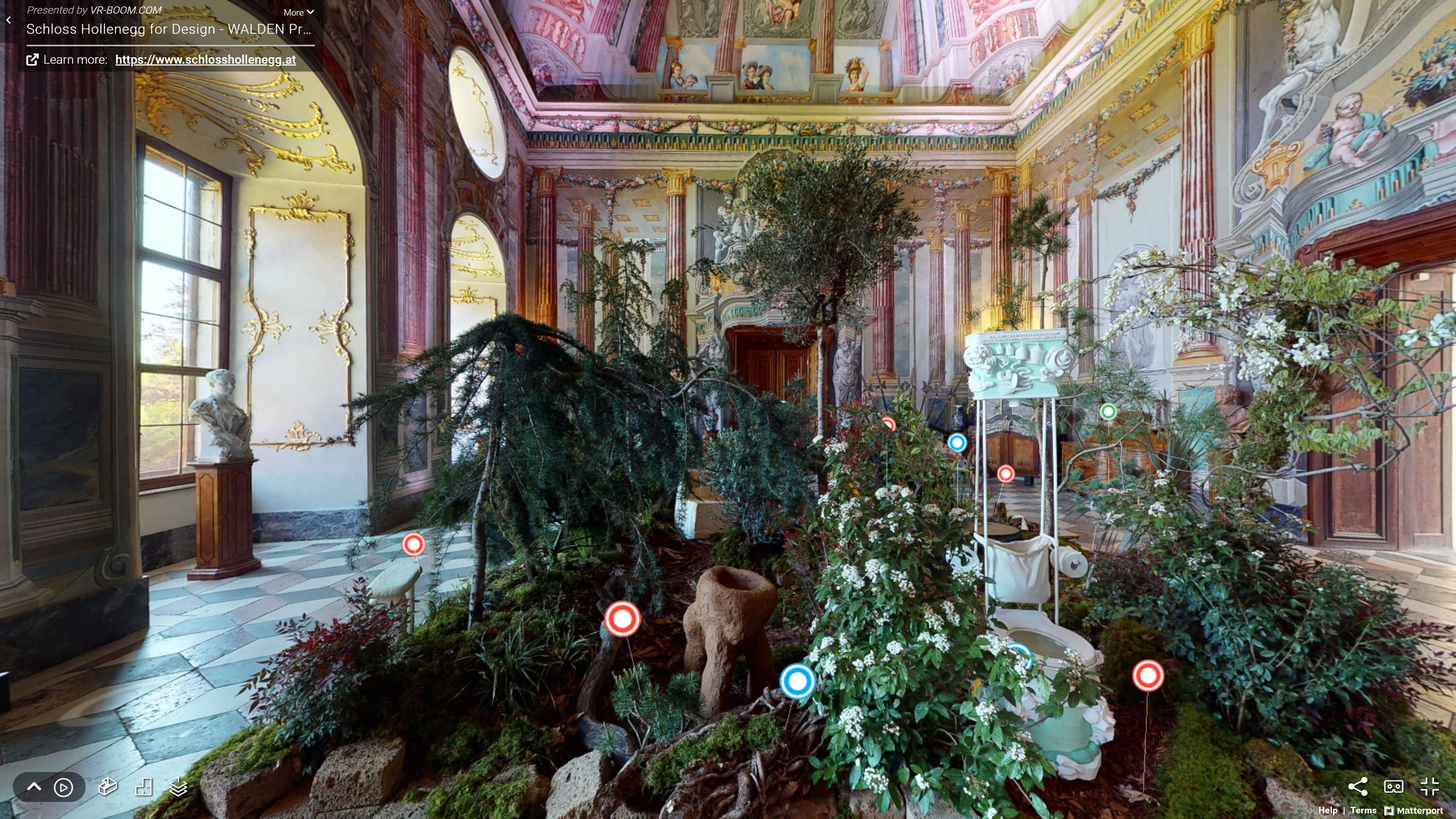
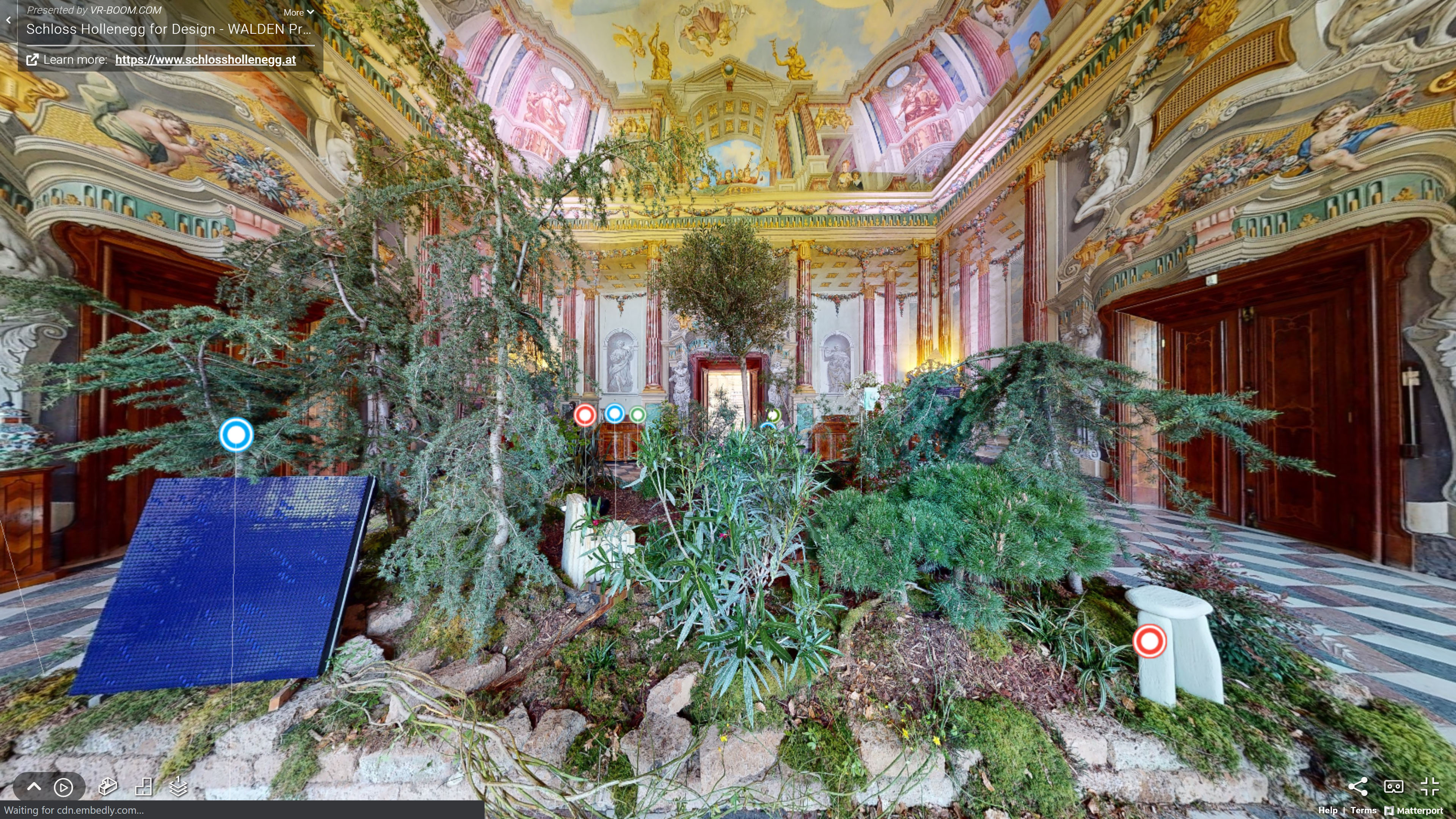
WALDEN 2020, zámok Hollenegg, screenshot z virtuálnej prezentácie.
Poďme konkrétne k výstave Walden. Ako ste naformulovali zadanie pre pozvaných dizajnérov a dizajnérky a kde sa ukázali limity?
Pokyny boli veľmi jasné: Chcela som udržať rozhovor o ekológii pri živote, ale bez všetkých tých v súčasnosti bežných spolitizovaných naratívov a naratívov, ktoré majú v človeku vyvolať pocit viny. Preto som ich poprosila, aby priniesli niečo z divočiny do nášho všedného života. Väčšina vystavovaných projektov bola špeciálne navrhnutá a vyrobená pre výstavu, takže finálny výsledok do veľkej miery vytvarovali dizajnéri. Na začiatku som im dala zadanie a potom som ich už len usmerňovala, aby projekty boli rôznorodé, a zároveň sa dopĺňali. No tiež im ponechávam veľa slobody na rozvoj myšlienok a vízií.
V heštegoch k výstave pracujete s pojmom cirkulárny dizajn. Mohli by ste to viac vysvetliť? Ako ho vnímate vy v kontexte výstavy aj súčasnej dizajnérskej scény?
Cirkulárny dizajn sa riadi zásadami cirkulárnej ekonomiky, cieľom ktorej je obmedzenie odpadu a opätovné využívanie či recyklácia zdrojov. Cirkulárny dizajn by mal navrhovať produkty s dlhším využitím a hľadá inovatívne spôsoby využívania odpadu ako výrobného zdroja. Je to jedno z riešení, ako vyrábať veci a ako vytvoriť systém šetrnejší k životnému prostrediu.
Ktoré z vystavených prác projektov vás osobne najviac oslovili? Prekvapilo vás niečo?
Vždy ma vie prekvapiť, ako dizajnéri či dizajnérky na rezidencii zareagujú nielen na zadanie, ale aj na zámok, ako rôzne dokážu vtesnať svoj štýl a výskum do tohto historického miesta, ktoré určitým spôsobom aj zväzuje. Napríklad Crafting Plastics dokázali do priestoru vložiť absolútne organicky svoje okno, Charlap Hyman a Herrero vytvorili nadčasovú tapetu, Klemens Schillinger navrhol lampu pre tie miestnosti, kde nie je zavedená elektrina, a Marlene Huissoud sa zas inšpirovala hmyzom, ktorý obýva šľahúne popínavých rastlín.
Myslíte si, že po koronakríze sa svet vráti späť, alebo čo je pre vás na tomto období zaujímavé?
Určite by som bola veľmi rada, keby sa niektoré veci vrátili – chýba mi spoločnosť, pracovné kontakty a cestovanie. Niektoré zmeny, ktoré sa už i tak boli na spadnutie, sa však urýchlili. Stále sa snažím predstaviť si, ako konkrétne sa veci zmenia. V každom prípade, určite budeme považovať omnoho menej vecí za samozrejmosť!
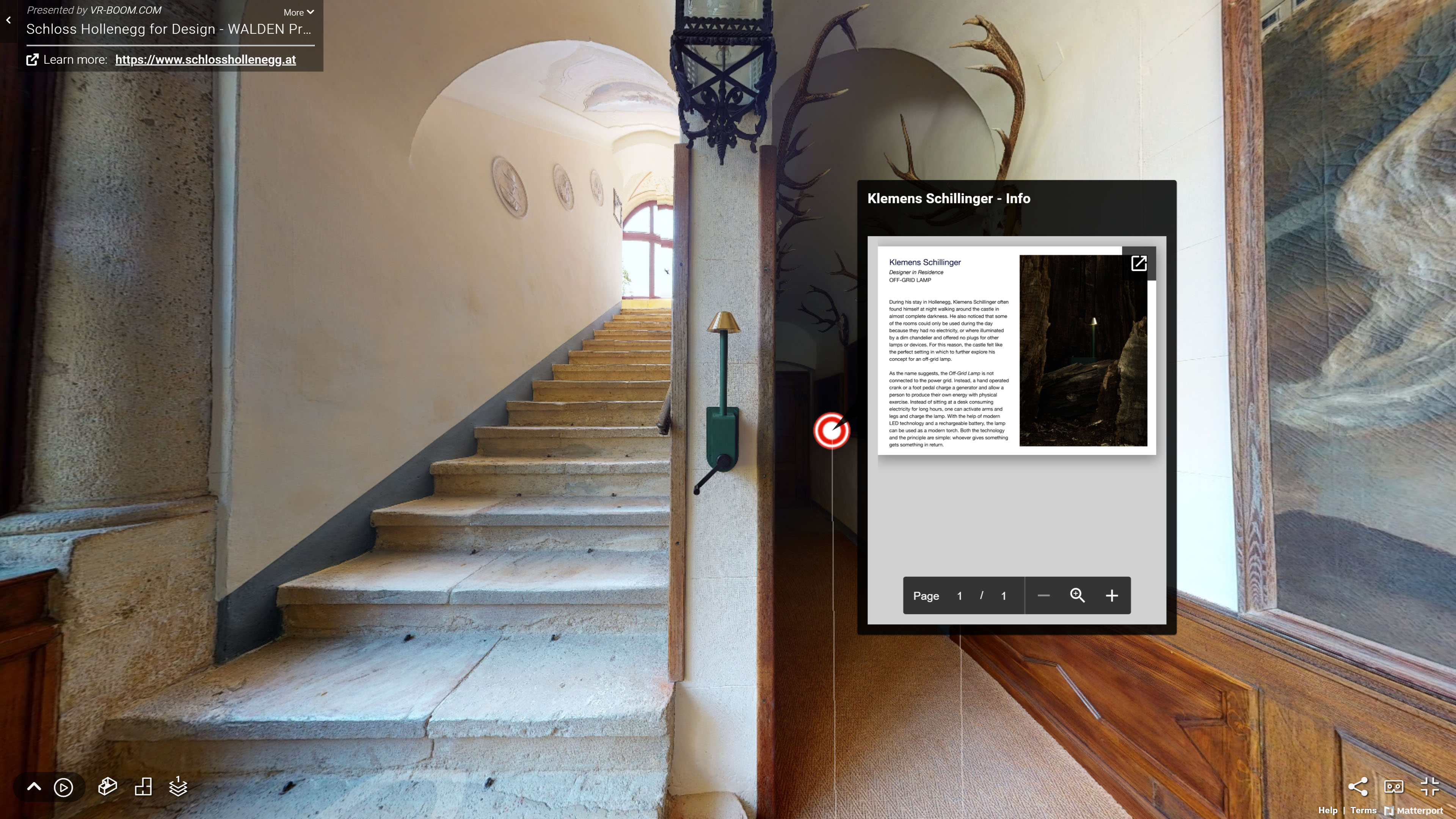
OFF-GRID LAMP, Klemens Schillinger, screenshot z virtuálnej prezentácie.
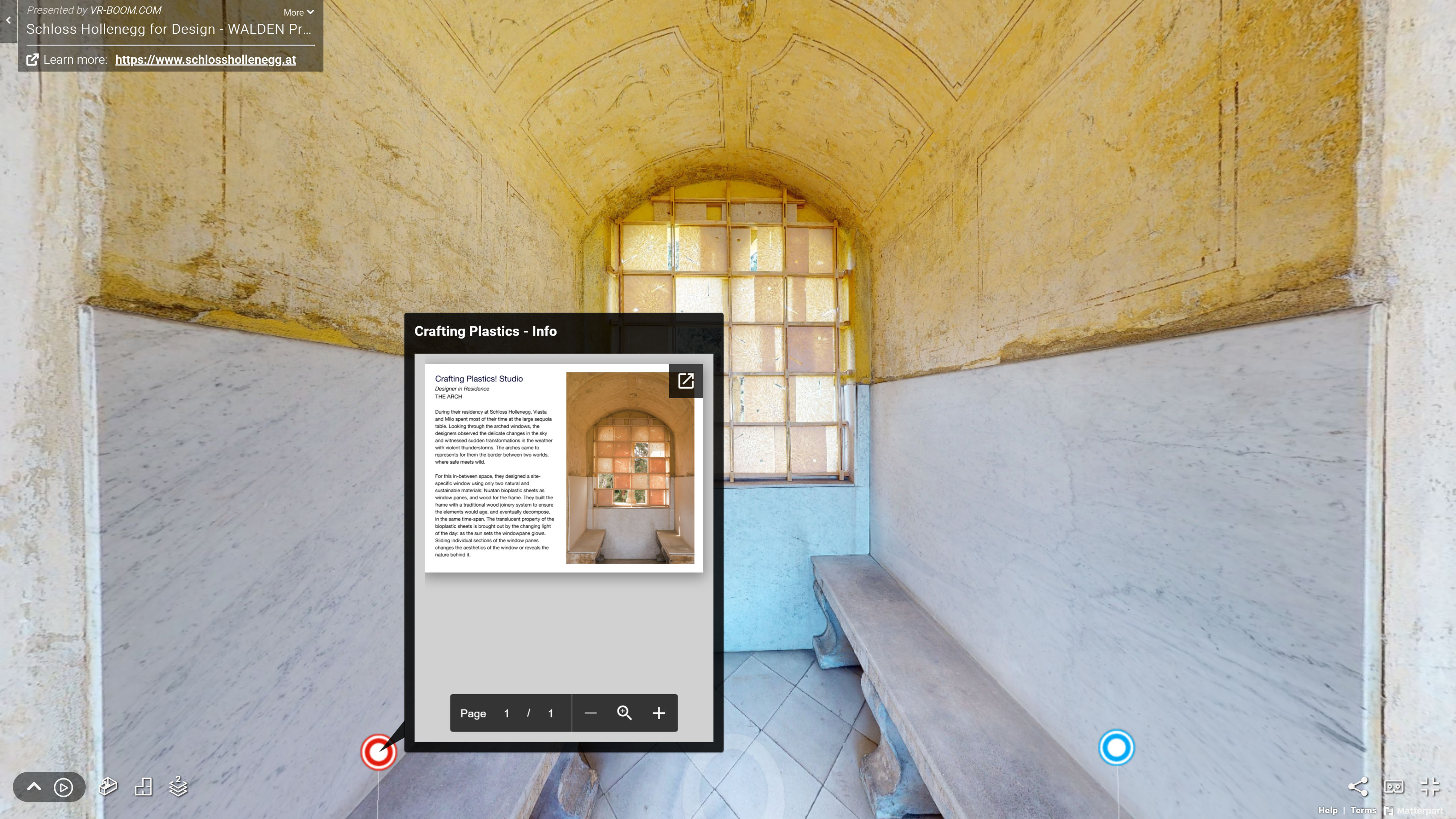
THE ARCH, Crafting Plastics! Studio, screenshot z virtuálnej prezentácie.
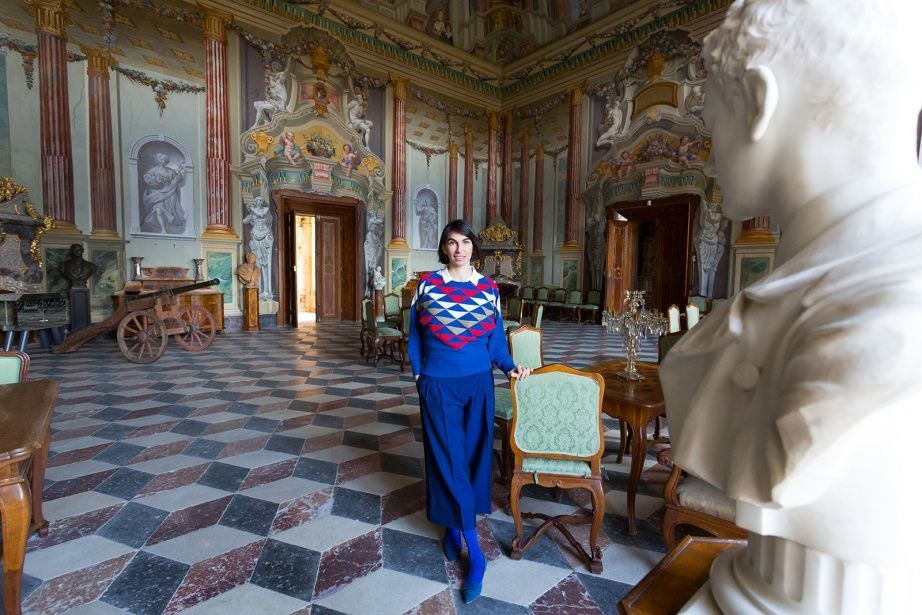
Alice Stori Liechtenstein
Rozhovor s Crafting Plastics!
LH: V čom vás oslovila koncepcia výstavy Walden?
CP: Téma výstavy Walden nám bola predstavená už počas našej rezidencie v zámku Hollenegg v lete 2019. Strávili sme tu skvelých 10 dní. Majitelia nám sprístupnili všetky miestnosti, napríklad sály s množstvami cenných kníh, dokumentov a artefaktov rodiny Liechtensteinovcov od konca 17. storočia. Bolo fasicnujúce videť takúto ucelenú zbierku a byť v tom prostredí. Koncepcia výstavy sa v tom čase ešte formovala, no dostali do rúk knižku od Itala Calvina, The Baron in the Trees, ktorá bola hlavnou inšpiráciou pre koncept Walden-u.
Povedali sme si, že výstava by mala otvoriť diskusie o súčasných, či budúcich vzťahoch medzi prírodou a človekom v akomsi prirodzenejšom, divokejšom súznení. Bolo zaujímavé nad tým premýšľať v kontexte historického zámku z 11. storočia, v ktorom akoby sa zastavil čas a divoká príroda v okolí nemala na neho až taký dosah, pretože bol stáročia udržiavaný rodinou Lichtenštajnovcov.
Nás zaujali dve veci – akýsi stret dvoch svetov vonkajšieho – divokého vs. vnútorného, ktorý tvoril ,safe’ place. A potom čas, ktorý akoby tam ani neplynul v spojení s materiálmi, ktoré v zámku pretrvali storočia. Veľa času sme strávili pozorovaním okolia zvnútra a rozhodli sme sa pracovať s priestorom medzi týmito dva svetmi. Chceli sme pracovať s pohľadom na krajinu, ktorú v našich očiach mení to, cez aký prostriedok/ materiál sa na ňu pozeráme.
Na druhej strane sme uvažovali nad tým, koľko by mala naša intervencia do zámku prežiť, vydržať. Mala by nás prežiť a zostať storočia? Alebo by sme už s ohľadom na súčasné premnoženie produktov a ľudí mali dizajnovať veci, ktoré tu zostanú presne toľko, koľko musia a potom ,splynú’ s prírodou?
Najviac sme premýšľali o čase a materiáli Rozhodli sme sa prepojiť materiál súčasno-budúcnosti, ktorý je pre našu tvorbu typický – prírodný bioplast a lokálny material, s ktorým rodina Liechtensteinovcom stáročia pracuje (vlastnia pílu) – drevo. Chceli sme vytvoriť intervenciu, ktorá bude spojená iba z týchto dvoch materiálov, bez použitia skrutiek, či lepidla. Tak, aby sa eventuálne mohli spoločne rozložiť za pár desiatok rokov a nezanechali negatívnu stopu. Konštrukciu sme realizovali v spolupráci so šikovným dizajnérom a remeselnikom Petrom Liškom, ktorý dlhodobo pracuje na udržateľnom spôsobe spájania dreva.
Výsledkom je ,the Arch’, okno, cez ktoré sme chceli priniesť nový pohľad na okolitú krajinu. Bioplastové dosky z Nuatanu sú navrhnuté tak, že sú translucentné a jeho časti menia tonalitu počas jednotlivých fáz dňa. Zároveň je naše okno/stena funkčným a hravým objektom, jednotlivé časti vieš zatvárať a otvárať, ručne, cez slidovanie a dotykom s jednotlivými doskami.
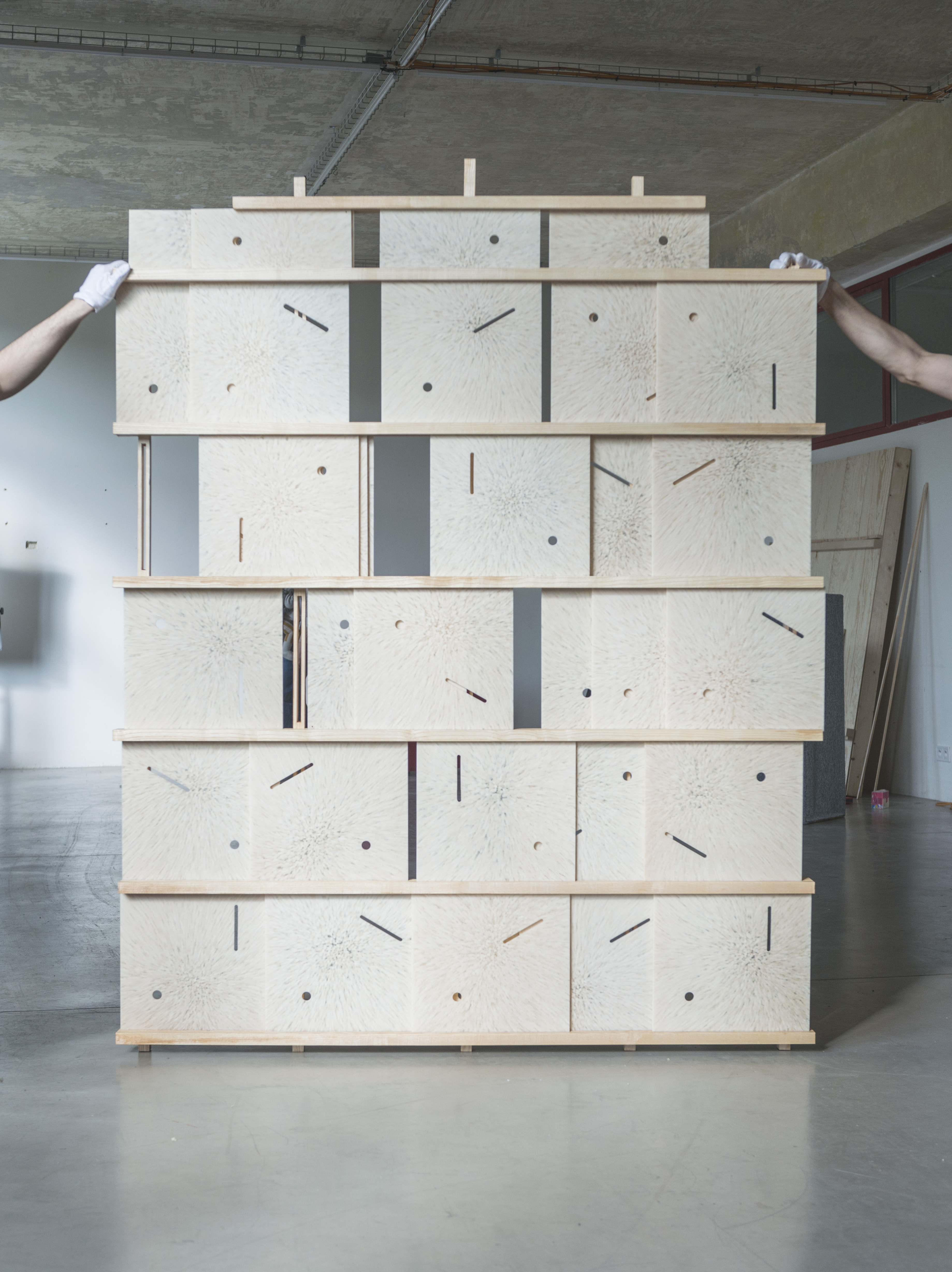
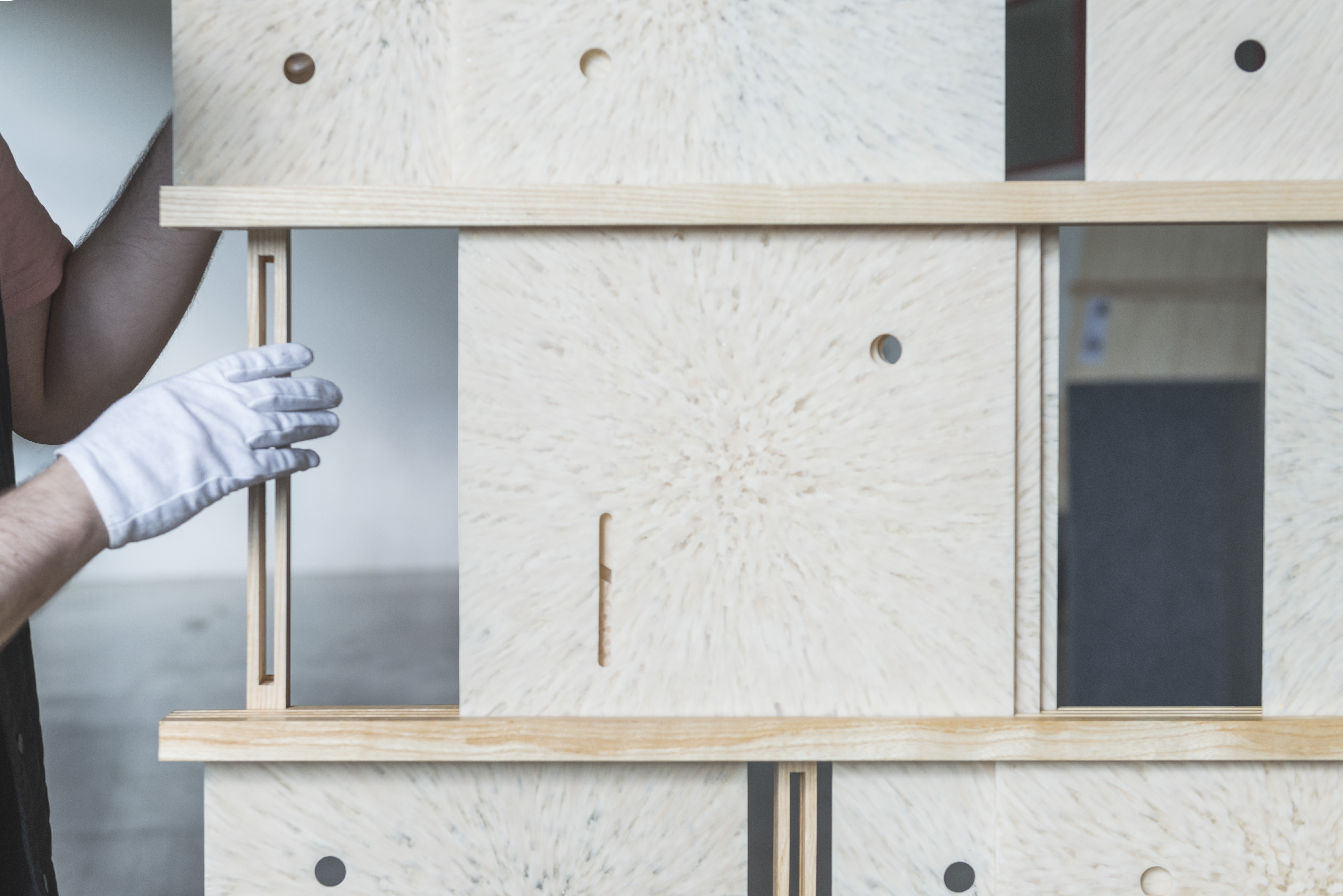
THE ARCH, Crafting Plastics! Studio, foto: Adam Šakový.
V heštegoch k výstave pracujete s pojmom cirkulárny dizajn. Mohla by si viac vysvetliť, ako to vnímaš ty v kontexte výstavy aj súčasnej dizajnérskej scény?
Cirkulárny dizajn je pre nás akýmsi východiskom a znamená byť si vedomý celého cyklu života produktu či projektu, na ktorom pracujeme. Cirkulárny dizajn je apelom na lineárny spôsob navrhovania a výroby produktov, v ktorom je dôležitý iba čas jeho využívania a to, čo sa stane potom by už mal riešiť niekto iný. My si myslíme, že rozmýšľať nad materiálmi a jeho ekologickým dopadom by malo byť MUST pre každého dizajnéra a jeho prax. Keď sa to tak stane, možno už nebude treba žiadne špeciálne hashtagy 🙂 Dizajnéri, ktorých Alice vyberala na túto výstavu sú tvorcovia, pre ktorých je udržateľný dizajn základom. A to sa nemusí nevyhnutne týkať iba tvorby nových materiálov.Mnoho z nich tvorí nové procesy produkcie, či skúmajú práve vzťahy medzi životom ľudí a iných obyvateľov tejto planéty. Za posledných 5 rokov sa cirkulárny dizajn dostáva, čím ďalej do popredia. Je to dobre, pretože sú mnohé projekty, ktoré naozaj idú do hĺbky problematiky. Myslíme si, že úlohou dizajnéra v súčasnosti by malo byť hľadanie spôsobov ako cez vlastnú prax navigovať aj priemysel aby menil svoje procesy z lineárnych na cirkulárne.
Výstava sa otvára v čase pandémie, teda v čase, keď sme silno pocítili akí sme malí oproti prírode a to poznanie bolo zhodou okolností aj jedno z východísk výstavy (kurátorky Alice Stori Liechtenstein). Ako zasiahla pandémia konkrétne do procesu príprav? Aj do vzniku vašej práce?
Vďaka pandémií sme mali viac času na odovzdanie a Peter Liška neskolaboval 😀 (píše Mirko) – (Miro Král)
Výroba nášho objektu bola pomerne zdĺhavá. Vedeli sme, čo chceme, ale hľadanie finálnej konštrukcie a aj postupné navrhovanie a doladovanie detailov sme robili v procese. Čiže sme mali o niečo viac času a to bolo dobre. Bohužiaľ sme nemohli ísť osobne na zámok inštalovať a hoci sa celá výstava fyzicky realizovala, jej otvorenie prebehlo online. Minulý rok sme v Schloss Hollenegg boli súčasťou Ad Mensam výstavy a hoci je veľkolepé otvorenie nezabudnuteľným zážitkom, nie je toľko ľudí, ktorí budú cestovať za Graz (tam sa nachádza ich zámok) počas trvania výstavy. Kvôli situácií s Covid- 19 sa Alice rozhodla urobiť 3D výstavu. Všetky projekty a otvorené miestnosti si tak mohli ľudia pozrieť do konca mája online na webe Schloss Hollenegg a na Adorno. Podľa mňa to je skvelý prostriedok a otvoriť takýto špecifický priestor širokej verejnosti.
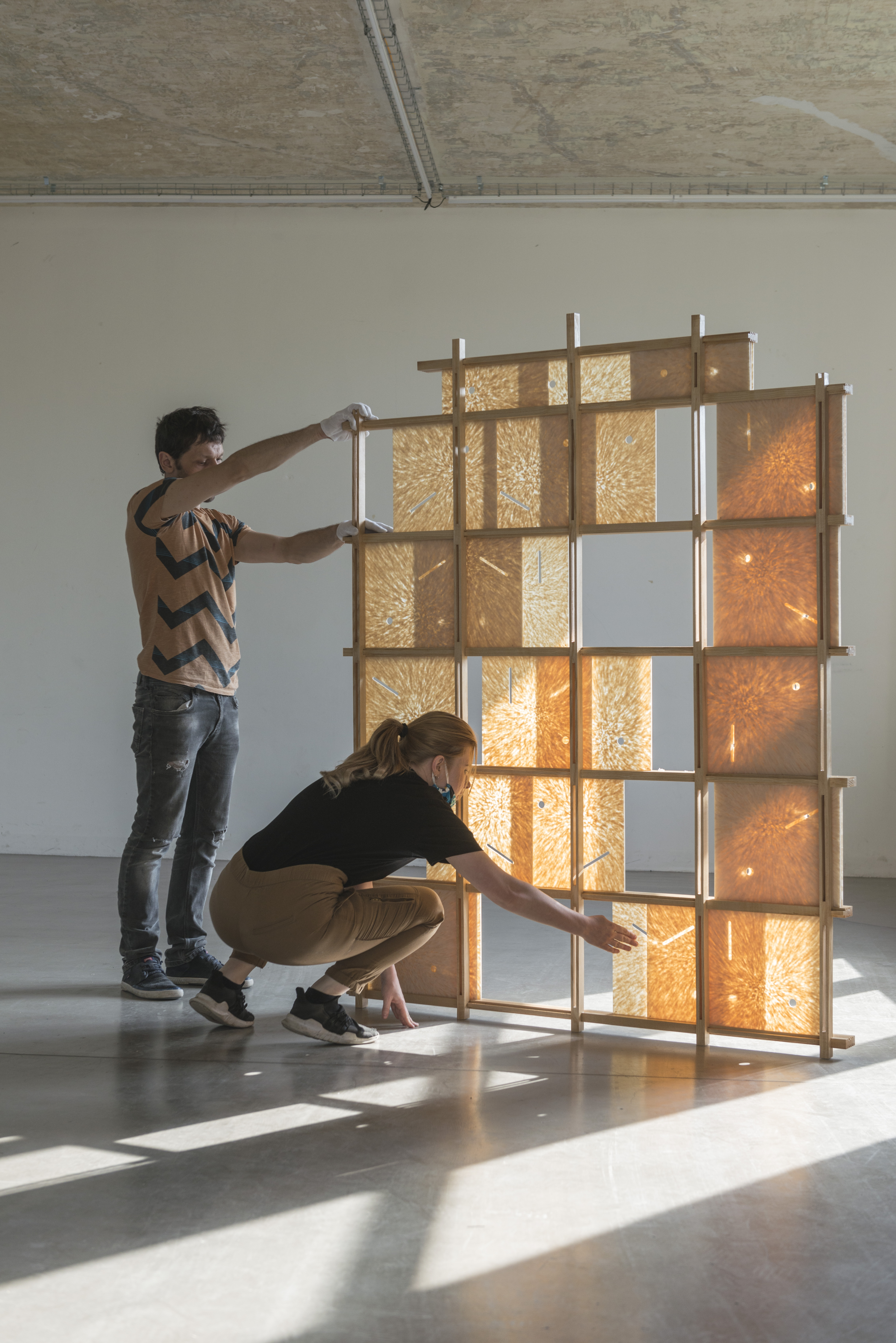
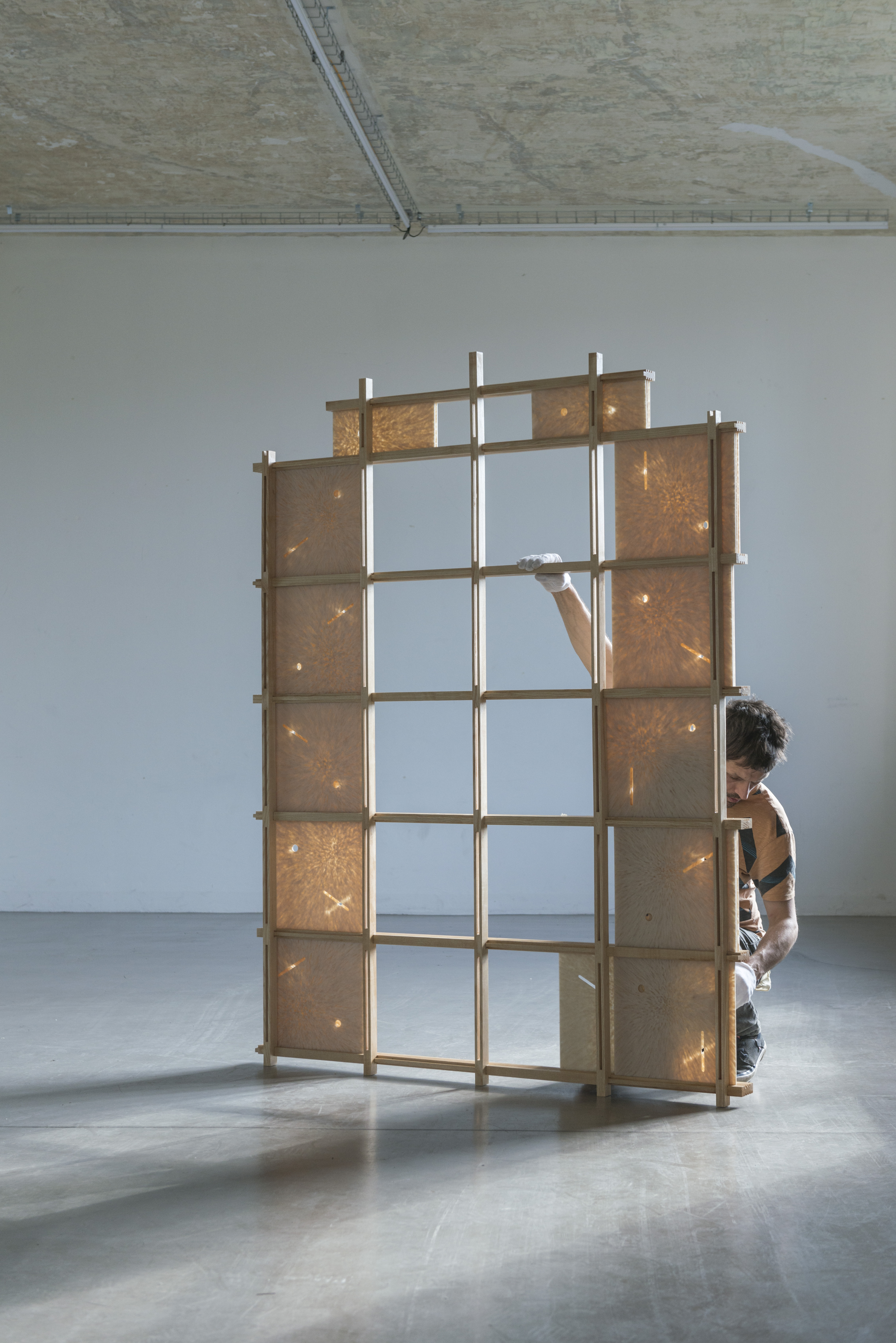
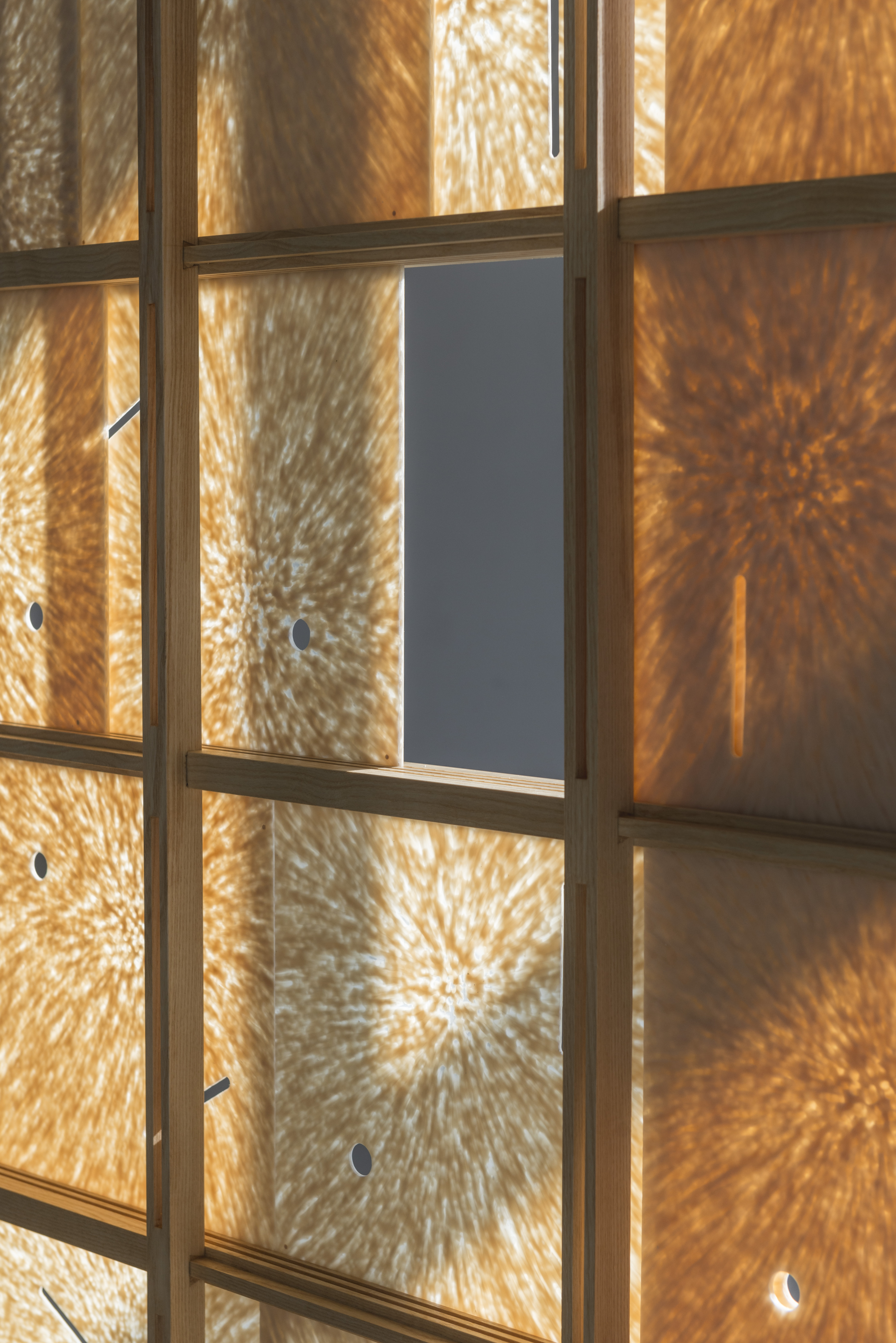
THE ARCH, Crafting Plastics! Studio, foto: Adam Šakový.
Povedz niečo viac o výstave. Ktoré z vystavených prác projektov ťa najviac oslovili a prečo?
Veľmi nás bavil projekt od Jonasa Edvarda, ktorý pracoval s hubami, konkrétne hlivou ustricovou. V priebehu niekoľkých týždňov spolu s textilnými a konopnými vláknami vytvoril pružnú textíliu a potom to dopestoval do pevnej kompozitnej štruktúry. Z nej potom vytvoril stoličku, ktorá po kompostovaní môže zlepšiť kvalitu pôdy. Ďalším zaujímavým projektom je Limted Grasses od našich obľúbených mischer’traxler ktorý patrí do ich projektov sústreďiacich sa na ohorozený hmyz a huby. Tento projekt sa zameriava na flóru, konkrétne na druh pšeničnej trávy, ktorej momentálne v Rakúsku zostalo už iba okolo 200.
A ešte by sme spomenuli Dry WC od Arvid & Marie, ktorý sa javí ako totem, ale v skutočnosti je to suchá toaleta. Hlavným princípom suchej toalety je zhromažďovať ľudský odpad na kompost a použitie ho ako hnojiva, namiesto jeho spláchnutia. Dry WC je niečo ako pamätník staršieho systému, archeologickým pozostatkom budúcnosti a alternatívou súčasnosti, ktorým je toaleta skrývajúca za hladkými krivkami objektu.
Prípadne Summloch od BNAG, kde je zaujímava interakcia s objektom, ktorý má bzučiace diery. Ak do neho dáte hlavu budete počuť bzučanie a bzučanie, ktoré vydávate vy spôsobuje rezonáciu objektu. Vibrácie a brnenie v tele by malo vyústiť v harmonickom pocite pohody.
Inak ale je ťažké hodnotiť bez toho aby sme pri objektoch aj fyzicky stáli alebo sa ich dotkli. Predsalen poznáme ich len z online priestoru.
Chápem, limity online sveta sú zrejmé, a je nám po tejto pandémii jasné, že reálny kontakt vedia nahradiť len do istej miery.
https://www.schlosshollenegg.at/exhibitions/walden
https://www.craftingplastics.com/
[:en]The Schloss Hollenegg for Design platform was set up by Alice Stori Liechtenstein who moved in with her husband Alfred and her three children to the Hollenegg castle (built in 1163) a few years ago.
In 2015, Alice started to support young and perspective (or as she calls them “emerging”) designers, making an artist residency space for research, focused thought and critical approach. Each year, she invites three or four designers to reside at her castle for about ten days to work around the theme brought up by the curator. The projects are then presented during the exhibition together with other ca. 20 designers from the world. We were talking to Alice Stori Liechtenstein and the designers from Crafting Plastic! that are showcased at the ongoing Walden exhibition opened at the beginning of May.
Interview with Alice Stori Liechtenstein
LH: The Walden exhibition at Schloss Hollenegg took place in non-standard – unique conditions of the world pandemic – how did you experience it and did it somehow affect your original curatorial concept?
ASL: I was in a sort of denial for a long time and was sure we would be able to open for the public. When I finally realised that that would not be the case, I had a moment of defeat before realizing I simply could not cancel. So I decided it was a wonderful time to experiment and try out different mediums. We made a video and a 3D mapping of the rooms so that the viewers would be able to explore the exhibition online. Also we live streamed the opening! It is obvious that however amazing technology can be it will never substitute the physical presence, but it is exciting to have tools at our disposal that allow us to discover and explore even when we are not able to travel.
The original concept of exhibition was very much about nature, especially about our dysfunctional and power relationship with it. Now nature has shown her full strength when the microscopic virus has paralysed almost the entire world.
Do you think that it will finally move society more towards real changes in favour of protecting the planet? And how do you think this will change the design community and its priorities?
I think that we need to change our approach to nature before we are able to save the planet. I don’t think it is necessary to choose between technology and environment or artificial and natural but we do need to have a different understanding of what it means to leave in symbiosis with nature. Nature is not romantic, we cannot opt for a sanitised, domesticated version of it. We need to stop seeing nature as a garden landscape to tame or protect. We need to embrace the undomesticated, feral side of nature and allow pockets of wilderness to take over. Being in lockdown has made us crave nature and has shown us how the moment we step back we are making space for plants and animals to take back their natural environment. I hope we will not forget immediately what we have experienced.
Could you explain a little bit more about the background of contemporary design exhibitions at Schloss Hollenegg, I know you’ve been the curator of several exhibitions?
Schloss Hollenegg for Design is a non profit institution and the aim is to support the growth and understanding of design culture. By creating a space and a place for design research, thinking and critique, Schloß Hollenegg for Design offers a stage to young, talented, emerging designers. Every year for the last five years we have organised a contemporary design exhibition in the historical rooms of the castel which are not normally open to the public. The idea is to discuss socially relevant topics and offer a cultural program in a non urban area.
WALDEN 2020, Schloss Hollenegg, screenshot from virtual exhibition.
Let’s go more specifically to the current exhibition Walden. How did you formulate the assignment for the designers and what were the limits?
The brief was very straightforward: I wanted to keep the conversation on ecology going but without any of the politicised and guilt inducing narrative which is so common at the moment. So I just asked them to bring a pocket of wilderness in our everyday life. Most of the projects we present are especially designed and produced for the exhibition, so I would say the designers shape a great deal the final outcome. I give the brief at the beginning and try and guide them along so that the projects are different and complementary, but I also leave a lot of freedom to them to develop their ideas and visions.
In the hashtags for the exhibition, you work with the term circular design, could you explain it more? How do you perceive this term (movement) in the context of the current design scene?
Circular design follows the principles of the circular economy, which aims at eliminating waste and reuse and recycle resources. Circular design should aim at designing products that are in use for longer, and looks at innovative ways to use waste as a resource for production. It is one of the solutions we have at our disposable to produce products and system which are more respectful of the environment.
Could you pinpoint some projects from the exhibition? Something that really surprised you?
I am always surprised by how the designers in residence respond not only to the brief but also to the castle and how they find ways of fitting their style and research within the historical constraints of the place. So Crafting Plastics have managed to insert a window seamlessly, Charlap Hyman and Herrero have created a timeless wallpaper, Klemens Schillinger has designed a lamp for those rooms that have no electricity and Marlene Huissoud was inspired by the insects that populate the vines.
Do you think, that after this experience the world will be as it used to be?
I would definitely love some things to go back to what they used to be – I miss the social contacts of work and the travelling, but I think some changes which were already due to happen have been accelerated. I am still trying to envisage in which ways things are going to be different. I think for sure we are going to take a lot less for granted!
OFF-GRID LAMP, Klemens Schillinger, screenshot from virtual exhibition.
THE ARCH, Crafting Plastics! Studio, screenshot from virtual exhibition.
Alice Stori Liechtenstein
Interview with Crafting Plastics!
LH: What was it that appealed to you about the concept of the exhibition?
CP: The concept of the Walden exhibition had been presented to us during our residency at the Hollenegg castle in summer 2019. We spent here 10 awesome days. The owners made all the rooms accessible, such as halls with piles of valuable books, documents and artifacts of Liechtenstein family going back to the end of the 17th century. It was fascinating to see such a comprehensive collection, to be in this environment. The concept of the exhibition had just been taking shape at that time, but they’d got hold of the book by Italo Calvino – The Baron in the Trees – and that was the inspiration for the theme of Walden.
So we told ourselves that the exhibition should open discussions on present or future relationships between nature and a human being in a more natural, feral harmony. It was interesting to think about it against the backdrop of the 12th century historical building where it seemed that time has stopped and the wilderness in its surroundings did not have such an impact on it, as it has been maintained by the house of Liechtenstein for centuries.
Two things caught our attention – a clash of two worlds: the wild one vs. the inner one (inside the castle) that stood for a “safe” space. And then there was time that did not seem to pass in union with the materials used in the castle that have endured centuries. We spent a lot of time observing the surroundings from inside and decided to work with this in-between space. We wanted to work with the view of a landscape that is changed depending on the means/material through which we look.
On the other hand, we wondered how long our intervention should last, hold out. Should it outlast us, should it stay here for centuries? Or should we consider the present abundance of products and people and design things that would stay here just for as long as necessary and then they just “merge” with nature?
Most of our thoughts were focused on time and material. We set about to link the material of presence-future – natural bioplastic (very typical for us) – and a local material used by the house of Liechtenstein for centuries (they own a wood mill) – wood. We wanted to make an intervention that would be made of just these two materials, without using any screws or glue, so they could decompose in a few decades, not leaving any negative print behind. The construction was realised in collaboration with a dexterous designer and craftsman Peter Liška that has been working on the sustainable wooden joinery system for a long time.
The result is „The Arch”, a window whose task is to bring a new view of the surrounding landscape. The bioplastic sheets made of Nuatan are translucent and their design allows for changing their tonality with different phases of the day. At the same time, our window/wall is a functional and playful object, you can close and open different sections manually, by sliding and touching individual sheets.
THE ARCH, Crafting Plastics! Studio, photo: Adam Šakový.
Your exhibition hashtags include the concept of circular design. Could you be more particular about it – how do you view it in the context of the exhibition and the design scene?
We see circular design as a starting point of sorts and it means to be aware of the whole life cycle of a product or project we work on. Circular design is a challenge to the prevailing linear way of designing and production. What matters to linear design is just the time of use of a product rather than its afterlife – what happens after should be tackled by someone else. However, we maintain that thinking about materials and considering their ecological impact should be a MUST for every designer and their practice. And when it happens, perhaps no special hashtags are needed any longer 🙂 The designers picked by Alice for this exhibition are creators committed to sustainable design. And it does not necessarily have to be about new materials. Many of them create new production processes or explore relationships between humans and other inhabitants of our planet. In fact, in the past five years circular design is coming to the fore more and more. It’s great, as there are many projects that go deep into the issue. We think that the task of designers should be to seek ways how their own practice could make the industry change their processes from linear to circular.
The exhibition is opening in the time of pandemic, i.e. when we felt quite hard how small we are in the face of nature. This knowledge was by chance one of the points of departure for the exhibition (by curator Alice Stori Liechtenstein). In what particular way did the pandemic interfere with the preparation process? Or with your work?
The pandemic actually gave us more time to submit the piece and Peter Liška did not break down 😀 (note by Miro Král).
Well, the making of the object itself was relatively lengthy. We knew what we wanted, but finding the final construction as well as continual designing and finetuning of details was carried out in the process. So we had a bit more time, which was good. Unfortunately, we could not install the object in person, although the whole exhibition was realised physically; its opening took place online. Last year we took part in the Ad Mensam exhibition in Schloss Hollenegg. The grand opening is always an unforgettable experience, yet there are not many people who would travel past Graz (that’s where the castle is located) during the exhibition. Due to COVID-19 crisis Alice decided to make a 3D exhibition.
So until the end of May, people could have a look at all the projects and open rooms on the websites of Schloss Hollenegg and Adorno. I guess it’s a great tool how to open up such a specific space to the broad public.
THE ARCH, Crafting Plastics! Studio, photo: Adam Šakový.
Which of the exhibits do you find most compelling and why?
We enjoyed the project by Jonas Edvard who used fungi, namely oyster mushroom. During a period of several weeks, he made a flexible textile using textile and hemp fibres, letting the mycelium grow through it. In the end, a solid composite structure came out and he used it to make a chair that can enhance the quality of the soil after composting. Another interesting project was Limited Grasses by our beloved mischer’traxler that belong to the projects addressing endangered insects and fungi. This one focuses on flora, particularly one species of crested wheatgrass, of which the specimens in Austria’s natural environment are estimated at about 200 plants.
And we should also mention Dry WC by Arvid & Marie that appears to be a totem, but in reality, it’s a dry toilet. The main principle of a toilet is to collect human waste for compost and fertilizer instead of flushing it. Dry WC is something like a memorial to an older system, an archeological relic of the future and an alternative for the present, a toilet hidden behind the smooth curves of the object. Or Summloch by BNAG – an interesting interaction between the object with buzzing holes. If you put your head into it, you will hear humming and the humming produced by you causes the object to resonate. Vibrations and tingling in your body should lead to a harmonious feeling of well-being. Either way, it’s hard to judge without physically standing next to the objects or even touching them. After all, we know them only from the virtual world.
I see, the limitations of the virtual world are evident and now after the pandemic it is clear it can only partially replace the real-life experience.
https://www.schlosshollenegg.at/exhibitions/walden
https://www.craftingplastics.com/
[:]