[:sk]Konfrontácie / MÝTUS_MODERNITA[:en]Confrontations / MYTH_MODERNITY[:]
[:sk]Jednotlivé texty série pozostávajú zo vzájomnej konfrontácie slov – Mesto, Mýtus, Modernita, Bazén. Vzájomnou konfrontáciou dvojíc slov nejde o potvrdenie jednoznačných vzťahov, harmonického celku, ale hľadanie možných nezhôd. Konfrontáciou sa zužuje široká škála ich jednotlivých významov.[:en]The individual texts of the series consist of a juxtaposition of words - City, Myth, Modernity, Pool. The mutual confrontation of pairs of words is not about confirming unambiguous relations, a harmonious whole, but about searching for possible disagreements. The confrontation narrows the wide range of their individual meanings.[:]
[:sk]
„Alegória je v ríši myšlienok tým, čím je ruina v ríši vecí.“[1]
Alegória je z literárneho hľadiska (básnickým) trópom, tj. výrazovým prostriedkom, ktorý nepriamo označuje predmety, javy, na základe podobnosti, vecných alebo logických súvislostí, kontrastu,… . Je druhom rozvitej metafory, obrazným pomenovaním, ktoré sa v dejinách objavuje v kontexte útlaku, kedy veci nemôžu byť pomenované priamo. Alegória sa objavuje v krízových časoch, keď sa spochybní niečo čo malo byť nemenné a trvalé.[2]
Alegória je obrazným vyjadrením myšienky, jej doslovný (primárny) význam nie je podstatný. Prvotný význam nemusí byť vôbec zmysluplný (racionálny). Ide o fiktívny, vonkajší príbeh, ktorý skrze interpretačné kľúče maskuje druhý myslený (reálny príbeh), v ktorom spočíva skutočný význam alegórie. Ide o princíp dvoch súbežných textov, (rozprávaného/ písaného/ zobrazeného) a mysleného.
Ruina by mala byť podľa Benjaminovej analógie s alegóriou fiktívnym obrazom/ textom ukrývajúcim iný význam. Z môjho pohľadu majú alegória a ruina opačný kauzálny sled obrazu a významu. V kontexte fungovania alegórie, predpokladám prvotnosť významu (obsahu), na ktorý sa vytvorí krycí obraz. Ruiny sú obrazom, ktorý svojim postupným vznikom zároveň podmieňuje vpisovanie významu (obsahu). Ak je ruina obrazom efemérnosti, pominuteľnosti ideý, ktoré stáli za konštrukciou celku, ktorého bola súčasťou, tieto následné konotácie sa na ňu prilepujú až v stave ruinizácie. Ruina nie je zámernou ilustráciou pominuteľnosti, ale naopak.
Ruiny vznikajú rôznymi procesmi. Alebo vzniknú odrazu, ako zámerné hotové fyzické ruiny umiestňované do záhrad predminulého storočia. Takéto ruiny na mysli nemám. Ruinami myslím reálne alebo symbolické torzá, fragment predošlých (ideových) celkov. Fyzické ruiny vznikajú opotrebením časom, ľudským násilím, prírodnými katastrofami. Ruinami myslím fyzické pozostatky, alebo len ideové (nezrealizované časti alebo celé projekty). Ruinami myslím materiálne zachovalé objekty, ktoré sú stále v prevádzke, ale sú vyslúžilé morálne. Myslím na ideologicky poznačené a skompromitované torzá stavieb. Vyprázdnené formy, ktoré stratili svoju pôvodnú náplň, zmysel, odchýlili sa od pôvodného zámeru.
Ruina je pozostatkom celku, už ale nie je tým pôvodným celkom. Nie je charakteristickým výsekom, prierezom celku, ktorý referuje o jeho vlastnostiach, vnútorných vzťahoch, fungovaní. V procese ruinizácie sa z tohto fragment stáva nový objekt, ktorý už len veľmi málo reprezentuje predchádzajúci významový celok. Je rozbitým rádom vecí.
Na rozdiel od alegórie nie je podstatou barthesovského mýtu skrývanie, ale deformácia, naturalizácia historických javov. Alegória je skrývaním z dôvodu nemožnosti v danej dobe veci pomenovávať priamo. Text vonkajší a text vnútorný. Moderný (barthesovský) mýtus nie sú dva súbežné, v podstate oddelené texty, spojené na základe podobností. Mýtus namiesto toho aby svoj koncept jednoznačne odhalil alebo zlikvidoval, ho naturalizuje. Jeho podstatou je nejednoznačnosť, oscilácia, vytvára umelú kauzalitu.
V tomto kontexte vnímam ruinu v jej ambivalencii, oscilujúcu medzi rozsudkom smrti a permanenciou ako príhodný materiál pre mýtus. Mýtus sa zmocní vyprázdnenej formy a napĺňa ju novými obsahmi (konceptom). Mýtus nikdy nepracuje s celkovým obrazom, ale s obrazom nekompletným – fragmentom, torzom, ktorým ruina je. Stáva sa vďačnou mytickou formou, ktorá sa stáva nositeľom dobových (ideologických) diskurzov.
„Hra je už rozohraná, kocky sú hodené, nasledované podmienkou, že ich môžeme znova vziať a hodiť nanovo.“[3]
Záujem o ruiny spočíva v záujme o rozpadnuté koncepty. Ruiny neodkazujú k trvalosti pôvodného konceptu, ale k jeho krehkosti, dočasnosti a pominuteľnosti. Prítomnosť ruiny je svedectvom (nepredpokladaného) rozpadu ideálu.
„Oni začali epos a my sme ho skončili. My sme videli výsledky, zatiaľ čo oni videli len projekt. Oni boli na začiatku, osobitej predohry symfónie, rozuzlenie pripadlo nám.“[4]
Ruina, ako vyprázdnená forma, označuje absenciu niekdajšej prítomnosti. Jej ostentatívnou existenciou (hoci ideologicky/ programovo/ funkčne vyprázdnenou), vlastnosťou prijímať stale nové obsahy, demonštruje svoju relatívnu autonómiu. Napĺňanie vždy novými významami je kompenzáciou miznúcej minulosti a zároveň spôsobom kontinuity. Sémantická, resp. ideologická nulifikácia významov je spôsobom ako ruiny oslobodiť, a vždy nanovo apropriovať. Tieto živé ruiny sa stávajú premenlivými monumentami. Kontinuita sa zachováva napriek/ práve vďaka neustálemu prepisovaniu stroskotaných ambícií predošlých rádov.
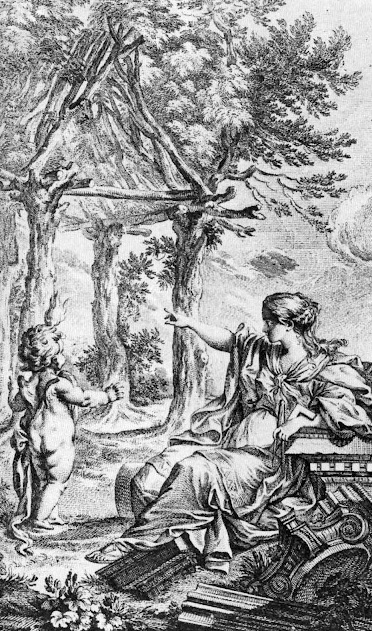
Frontispiece druhého vydania knihy Essai sur l’Architecture (1755) od francúzskeho umelca Charlesa Eisena, zdroj: primitivehuts.blogspot.com
Jedným z najvýznamnejších mýtov moderny je stvoriteľský mýtus, ilustrovaný Abbé Laugierom v 18. storočí – primitívna chatrč. Za týmto mýtom stojí koncept architektúry ako produktu nevyhnutnosti, potreby ochrany. V čase keď modernizmus ako ucelený naratív prechádzal obdobím krízy, objavilo sa množstvo ďalších malých naratívov. Superstudio voči tomuto funkcionalistickému, racionálnemu konceptu položilo svoj vlastný stvoriteľský mýtus. Architektúra už neslúžila žiadnému účelu okrem bytia sama sebou. Za začiatok architektúry zvolili kocku. Moderinzmus sa stal ruinou, na troskách ktorej vznikajú nové šance na prežitie.
Na základe princípu moderného barthesovského mýtu som chcela zdôrazniť relatívnu autonómiu formy, podľa potreby, situácie vyprázdňovanej a napĺňanej stále novými obsahmi. Na druhej strane na potenciu úlomkov projektov (ideý), ktoré sa stávajú živnou pôdou pre ďalšie preprojektovania.
1 BENJAMIN, W. Trauerspiel. In: Gesammelte Schriften. Frankfurt am Main: Suhrkamp, 1972 – 1989, s. 354. Zdroj: BEDARD, J.-F. Cities of Artificial Excavation: the Work of Peter Eisenman, 1978 – 1988. New York: Rizzoli, 1994, s. 107.
2 HAYS, K., M. Allegory unto Death: An Etiology of Eisenman´s Repetition. In: Bedard, J.-F., 1994, s. 107.
3 LACAN, J. Seminar. Zdroj: Bedard, J.-F., 1994, s. 107.
4 KABAKOV, I. Utopia and Reality: El Lissitzky, Ilya and Emilia Kabakov [Exhibition Catalogue]. Zdroj: Wai Think Tank. Palace of failed Optimism, s. 61 – 62.
[:en]”Allegory is in the realm of ideas what ruin is in the realm of things.”[1]
In literary terms, allegory is a (poetic) trope, i.e. a means of expression that indirectly designates objects, phenomena, on the basis of similarity, factual or logical connections, contrast,… . It is a kind of developed metaphor, a figurative naming that appears in history in the context of oppression, when things cannot be named directly. Allegory appears in times of crisis, when something that was supposed to be immutable and permanent is called into question.[2]
Allegory is a figurative expression of thought; its literal (primary) meaning is not essential. The primary meaning may not be meaningful (rational) at all. It is a fictitious, external story which, through interpretive keys, masks a second thought (real story) in which the real meaning of the allegory lies. It is the principle of two simultaneous texts, the (narrated/written/imagined) and the thought.
According to Benjamin’s analogy with allegory, the ruin should be a fictional image/text hiding another meaning. In my view, allegory and ruin have an opposite causal sequence of image and meaning. In the context of the operation of allegory, I assume the primordiality of the meaning (content) for which a cover image is created. Ruins are an image which, by its gradual emergence, also conditions the inscription of meaning (content). If the ruin is an image of ephemerality, of the transience of the ideas that stood behind the construction of the whole of which it was a part, these subsequent connotations only stick to it in the state of ruinization. The ruin is not a deliberate illustration of transience, but the opposite.
Ruins are created by different processes. Or they come into being by reflection, like the deliberate finished physical ruins placed in the gardens of the century before last. I have no such ruins in mind. By ruins I mean real or symbolic torsos, fragments of previous (ideational) wholes. Physical ruins are created by the wear and tear of time, human violence, natural disasters. By ruins I mean physical remains, or just ideational (unrealized parts or whole projects). By ruins I mean materially preserved objects that are still in use but are morally retired. I think of ideologically tainted and compromised torsos of buildings. Empty forms that have lost their original content, meaning, deviated from their original intention.
The ruin is a remnant of the whole, but it is no longer the original whole. It is not a characteristic section, a cross-section of the whole, which refers to its characteristics, internal relations, functioning. In the process of ruinization, this fragment becomes a new object that no longer represents the previous meaningful whole very much at all. It is a broken order of things.
Unlike allegory, the essence of the Barthesian myth is not concealment but distortion, naturalization of historical phenomena. Allegory is concealment because of the impossibility of naming things directly at a given time. The external text and the internal text. The modern (Barthesian) myth is not two parallel, essentially separate texts, united on the basis of similarities. Rather than unequivocally revealing or discarding its concept, the myth naturalizes it. Its essence is ambiguity, oscillation, it creates an artificial causality.
In this context, I see ruin in its ambivalence, oscillating between death sentence and permanence, as a fitting material for myth. Myth takes possession of the emptied form and fills it with new contents (concept). Myth never works with the total image, but with the incomplete image – the fragment, the torso that the ruin is. It becomes a grateful mythic form that becomes the vehicle of contemporary (ideological) discourses.
“The game is already played, the dice are rolled, followed by the condition that we can pick them up again and roll again.”[3]
The interest in ruins lies in the interest in decayed concepts. Ruins do not refer to the permanence of the original concept, but to its fragility, temporariness, and transience. The presence of a ruin bears witness to the (unforeseen) disintegration of an ideal.
“They started the epic and we ended it. We saw the results, while they saw only the project. They were at the beginning, the particular overture of the symphony; the denouement fell to us.”[4]
Ruin, as an emptied form, denotes the absence of a former presence. By its ostentatious existence (albeit ideologically/ programmatically/ functionally emptied), by its property of receiving constantly new contents, it demonstrates its relative autonomy. Filling it always with new meanings is both a compensation for the disappearing past and a way of continuity. The semantic or ideological nullification of meanings is a way of liberating the ruins and always re-appropriating them. These living ruins become mutable monuments. Continuity is maintained despite/precisely because of the constant rewriting of the shipwrecked ambitions of previous orders.
Frontispiece of the second edition of Essai sur l’Architecture (1755) by French artist Charles Eisen, source: primitivehuts.blogspot.com
One of the most important myths of modernity is the creation myth, exemplified by Abbé Laugier in the 18th century – the primitive hut. Behind this myth is the concept of architecture as a product of necessity, of the need for protection. At a time when modernism as a coherent narrative was going through a period of crisis, a number of other small narratives emerged. Against this functionalist, rationalist concept, Superstudio laid its own creation myth. Architecture no longer served any purpose other than being itself. They chose the cube as the beginning of architecture. Modernism became a ruin on the ruins of which new chances for survival were created.
Based on the principle of the modern Barthesian myth, I wanted to emphasize the relative autonomy of the form, emptied and filled with ever new contents as the situation demanded. On the other hand, on the potency of the fragments of projects (ideas) that become fertile ground for further re-projections.
1 BENJAMIN, W. Trauerspiel. In: Gesammelte Schriften. Frankfurt am Main: Suhrkamp, 1972 – 1989, s. 354. Zdroj: BEDARD, J.-F. Cities of Artificial Excavation: the Work of Peter Eisenman, 1978 – 1988. New York: Rizzoli, 1994, p. 107.
2 HAYS, K., M. Allegory unto Death: An Etiology of Eisenman´s Repetition. In: Bedard, J.-F., 1994, p. 107.
3 LACAN, J. Seminar. Zdroj: Bedard, J.-F., 1994, p. 107.
4 KABAKOV, I. Utopia and Reality: El Lissitzky, Ilya and Emilia Kabakov [Exhibition Catalogue]. Zdroj: Wai Think Tank. Palace of failed Optimism, pp. 61 – 62.
[:]